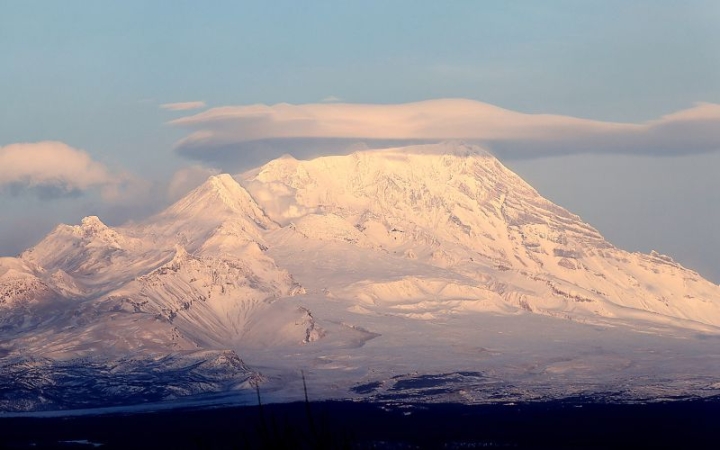
The remote village of Klyuchi in Russia’s far eastern Kamchatka Peninsula experienced an unusual phenomenon on the morning of January 24, as fine volcanic ash rained down, blanketing the area. Local media outlet Kamchatka.Today, citing the Kamchatka Volcanic Eruption Response Team (KVERT), reported that while such events are not uncommon in the volcanically active region, this particular ashfall was not the result of a fresh eruption but rather a consequence of past activity.
Satellite data confirmed that the airborne volcanic particles originated from the powerful eruption of the Shiveluch volcano in April 2023. A new cyclone, bringing strong winds to the Ust-Kamchatsky district, stirred up these ancient deposits from the volcano’s slopes, carrying them over Klyuchi. This meteorological phenomenon effectively resurrected ash from an almost year-old event, delivering it anew to the surrounding communities.
Remarkably, the pyroclastic flow deposits from the 2023 eruption have remained warm in certain areas, preventing them from being completely covered by snow. Scientists explain that these specific types of ash—dry and light—are highly susceptible to being lifted by strong winds. Once airborne, they can be transported significant distances, often hundreds of kilometers from the volcano’s vent, posing a lingering environmental concern.
It is crucial to distinguish this event from recent volcanic activity. Just a day prior, on January 23, Shiveluch had indeed registered a significant ash ejection, with a plume soaring 10 kilometers above sea level. However, this recent ash cloud drifted approximately 1,000 kilometers northeast of the volcano, long before the new cyclone impacted the Ust-Kamchatsky district. Volcanologists have therefore clarified that the ashfall witnessed in Klyuchi on January 24 was entirely unrelated to the previous day’s fresh eruption.
Shiveluch, standing at an imposing 3,283 meters, holds the distinction of being the northernmost active stratovolcano on the Kamchatka Peninsula, part of Russia’s dramatic ‘Ring of Fire.’ Located about 450 kilometers from the regional capital of Petropavlovsk-Kamchatsky, it is considered one of the most volatile and active volcanoes in the entire Kamchatka region. The village of Klyuchi, directly affected by this phenomenon, lies just 50 kilometers from its base, making its residents frequent observers of Shiveluch’s dynamic geological activity.