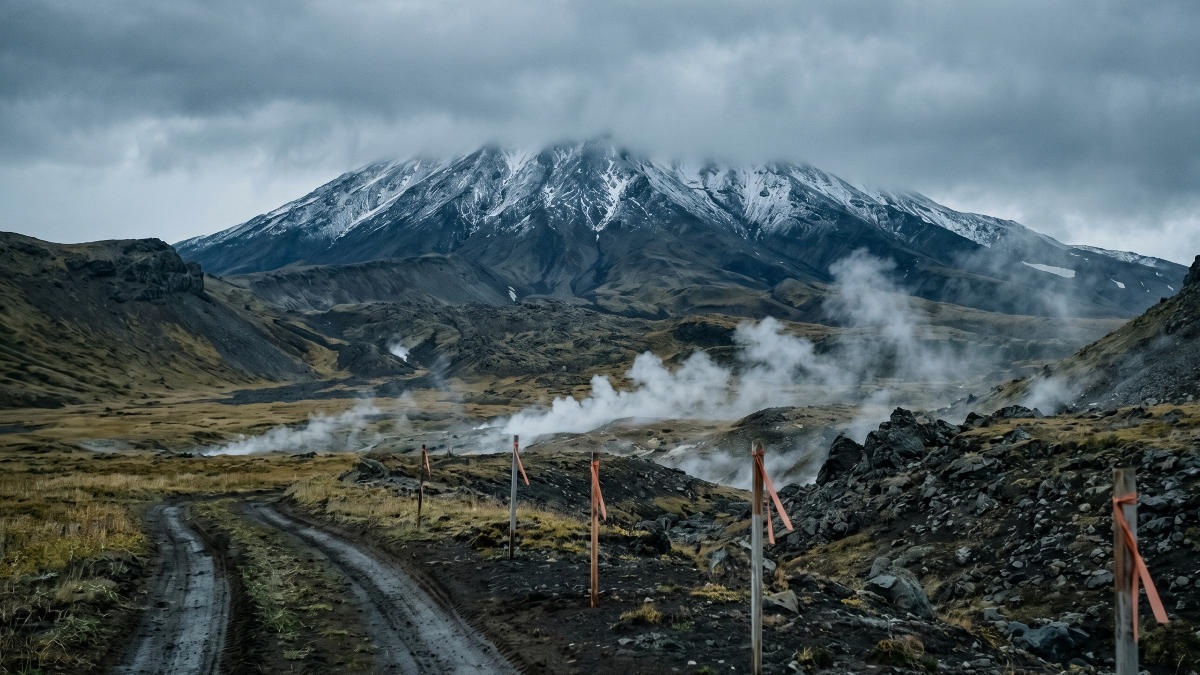
Interros, a major Russian holding company, is recalibrating its ambitious plans for the “Park Three Volcanoes” tourist cluster in Southern Kamchatka, a project drawing increasing international scrutiny due to its proximity and impact on a UNESCO World Natural Heritage site. The renowned Asadov architectural bureau has been tasked with adapting the original designs to reflect evolving economic realities and stringent environmental safety demands. Envisioned as a massive recreational complex, the site is strategically located approximately eighty kilometers from Petropavlovsk-Kamchatsky, nestled amidst the Vilyuchinsky, Mutnovsky, and Gorely volcanoes – a region globally celebrated for its unique thermal springs, intricate lava caves, and active fumarole fields.
However, the project’s development hinges on a contentious requirement: the excision of fifteen thousand hectares of land from the “South Kamchatka Nature Park,” an area formally recognized and protected under the prestigious UNESCO World Heritage Convention. This decision, initially approved five years ago by regional and federal authorities, allowed a substantial portion of these pristine protected lands to be reclassified for construction. The targeted landscapes include vital mountainous and coastal zones that serve as critical spawning grounds for Pacific salmon, as well as essential nesting habitats for rare avian species, notably the peregrine falcon and the iconic Steller’s sea eagle. Expert assessments indicate that approximately forty percent of the entire Steller’s sea eagle population recorded within the park’s boundaries inhabits these now-alienated territories.
Resort CEO Igor Dunaev asserts that the revised concept for “Park Three Volcanoes” prioritizes minimizing ecological disruption. Management claims the updated strategy incorporates renewable energy sources, aims to preserve the natural hydrological balance, and plans for diversified year-round recreation, including hiking and cycling trails, alongside the traditional ski infrastructure. The company further states its choice of designers was influenced by the need to navigate Kamchatka’s formidable natural constraints, promising state-of-the-art avalanche warning systems to ensure the safety of future ski routes.
Despite these assurances, the scientific community and environmental advocacy groups have voiced profound alarm, arguing that altering the park’s boundaries fundamentally undermines the integrity of the natural complex and constitutes a direct breach of the UNESCO Convention on the Protection of the World Cultural and Natural Heritage. Environmentalists underscore the irreversible nature of this land loss, emphasizing that the formal integrity of the protected complex, once compromised, cannot be restored. This situation in Kamchatka starkly illuminates broader challenges in environmental jurisprudence, where the mechanisms designed to safeguard unique natural territories frequently yield to criteria of economic expediency, thereby permitting the reclassification of protected areas for commercial exploitation.
Currently, Interros is undertaking a comprehensive review of the resort’s technical and economic parameters to ensure its viability amidst new market conditions. Following the architectural bureau’s work, the revamped concept will undergo multiple stages of approval by government agencies. In a move perhaps aimed at mitigating criticism, the “Kompas” foundation is slated to participate in the environmental expertise of the project documentation, having already formalized an agreement for environmental oversight with the cluster’s management.