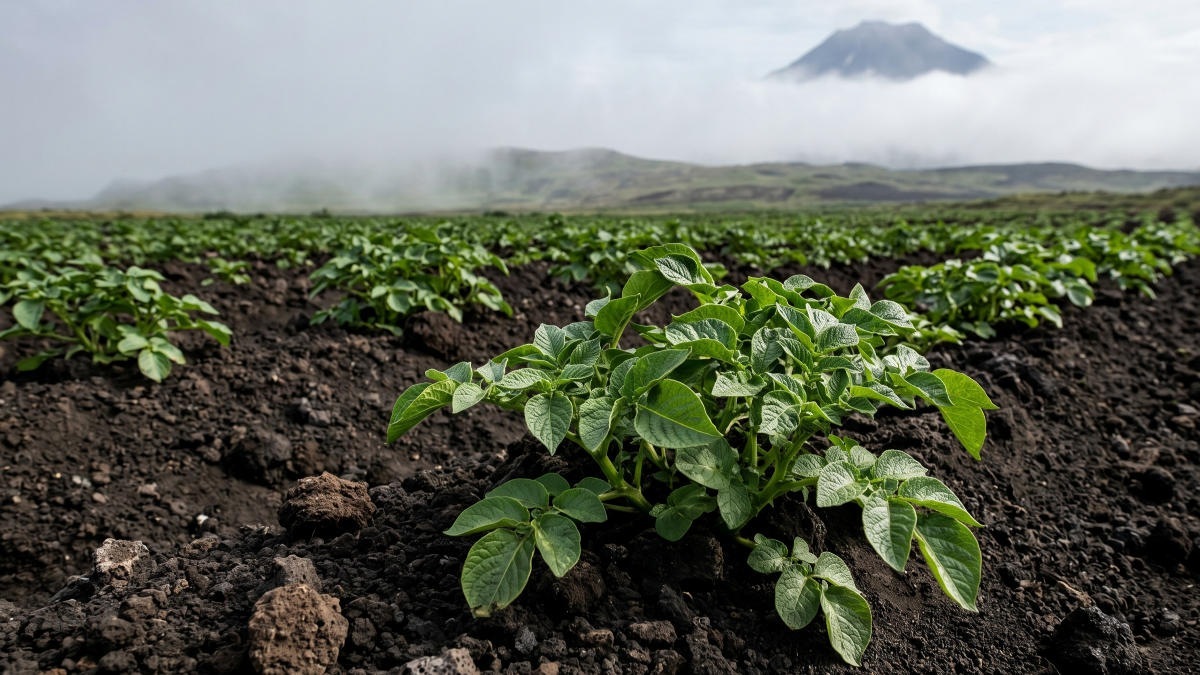
In a remarkable display of agricultural innovation against formidable odds, Russia’s remote Kamchatka Peninsula is emerging as a critical hub for high-quality, virus-free seed potato production. Despite a severely constrained growing season – a mere 80-90 days dictated by volcanic soils, nitrogen scarcity, and persistent ocean fogs – a large-scale testing program for domestic potato varieties has concluded its inaugural year with exceptional results, signaling a potential paradigm shift for Russian agriculture.
The initial findings from a collaborative effort involving eleven scientific organizations, coordinated by the Vitus Bering Kamchatka State University, are highly promising. Out of forty genotypes tested, eighteen demonstrated yields superior to the local standard, with some plots reporting a doubling in harvest. This success story is particularly striking given the peninsula’s harsh climate, which would typically challenge even the most resilient crops.
Central to Kamchatka’s unique advantage is its complete absence of aphids, notorious carriers of plant diseases that plague agricultural zones worldwide by significantly increasing the viral load in seed material and leading to crop degeneration. This natural climatic and geographic isolation allows for the cultivation of exceptionally healthy tubers of high reproduction quality. Consequently, Kamchatka is poised to gain federal status as a center for virus-free seed potato production, with plans to supply pristine planting material to Russia’s central and southern regions. Experts caution, however, that while the tubers will be robust, each variety will still require rigorous testing for adaptability to local photoperiods and accumulated temperatures in new environments.
Natalia Shvachko, Deputy Director for Scientific and Organizational Work at the Vavilov All-Russian Institute of Plant Genetic Resources, emphasizes that mere survival is insufficient; an adapted variety must consistently yield a stable harvest. This adaptation involves the plant re-calibrating its physiological rhythm – rapidly setting tubers, conserving energy on foliage growth, and efficiently extracting nutrients from impoverished soil. In the Kamchatka experiments, the proportion of seed-grade potatoes reached an impressive 47–49 percent, meaning nearly half of the harvested crop is suitable for further propagation. This high percentage of marketable material underscores the varieties’ ability to complete their full growth cycle within Kamchatka’s unforgiving weather window, a critical factor for economic viability before the onset of early frosts.
Breeders employ a sophisticated combination of classical hybridization and marker-assisted selection. While field selection remains crucial for observing a plant’s true environmental response—something laboratory conditions cannot replicate—molecular markers allow scientists to identify promising genetic forms without years of waiting. Crucially, Russian scientists draw a clear distinction between accelerated breeding, which intensifies natural cross-pollination processes without direct DNA alteration, and genetic modification (GMOs). In Russia, genomic manipulation is not permitted for commercial use, a stance rooted not only in legal frameworks but also in ethical considerations and a cautious public perception of GMO technology.
The unique mineral composition of Kamchatka’s light volcanic soils further contributes to the distinct properties of the tubers. While precise flavor distinctions await laboratory verification, the region possesses a strong foundation for developing a local food brand built on the concept of ‘terroir’ – the unique interplay of land and climate. To safeguard harvests against unpredictable weather anomalies, such as excessive moisture or early colds, agronomists are strategically developing a portfolio of potato varieties with varying maturation times, mitigating the high risks associated with relying on a single, universal option in an unpredictable climate.
Building on the success in Kamchatka, the developed seed production methodology is slated for application in other challenging climatic zones across Russia, including Chukotka, Sakhalin, Magadan, and Yakutia. However, mechanical replication is ruled out; scientists acknowledge that each region, with its unique permafrost conditions, extreme temperature fluctuations, or excessive humidity, will necessitate a tailored approach to varietal selection and protection systems. This adaptive strategy will also be crucial for scaling the program to other vegetables or fodder crops, as each species possesses distinct biology and pest vulnerabilities, requiring separate, multi-year field trials for successful expansion. This comprehensive approach underscores Russia’s commitment to bolstering its agricultural resilience and food security through scientific innovation in some of the world’s harshest environments.