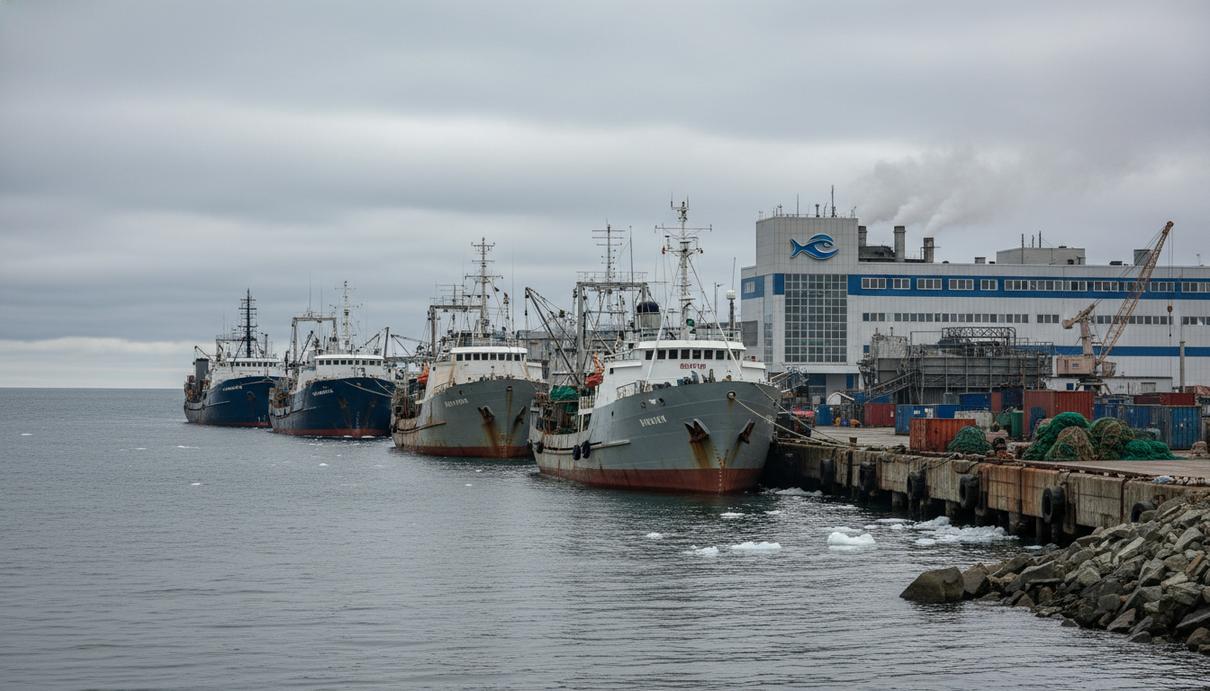
Russia’s vast fishing industry registered a year of stark contrasts and record financial achievements in the past year, even as overall catch volumes declined. The sector’s enterprises collectively surpassed 1.2 trillion rubles in revenue, with net profits soaring by half to 206 billion rubles. This impressive financial upturn positions Russia as a significant global player in marine resource exploitation, despite a notable dip in the total harvest.
However, the total aquatic biological resources harvested amounted to 4.7 million tons, a decrease of 200,000 tons compared to the previous period. This downturn was primarily attributed to an unexpected shift in the migration patterns of Ivasi sardines, which failed to enter Russia’s exclusive economic zone. Despite this, specific regions and species demonstrated remarkable growth. The Far Eastern basin, for instance, saw its pollock catch exceed two million tons for the first time in a quarter-century, while Pacific herring hauls hit a historic high of 596,000 tons. Kamchatka, maintaining its status as the nation’s primary fishing region, also reported a significant surge in salmon catches, increasing by over 40 percent in some areas. These robust yields were critical in satisfying domestic market demands and solidifying Russia’s standing among the top five global fishing nations, with exports exceeding two million tons and generating 6.5 billion dollars.
An analysis of Russia’s foreign trade operations in the sector, however, revealed a significant economic imbalance: while two million tons of fish were exported for $6.5 billion, the country imported 700,000 tons of seafood costing $3.5 billion. This disparity underscores a reliance on exporting raw materials while importing higher-value processed products. In response, the Russian government has intensified its ‘investment quotas’ mechanism, a strategic initiative designed to modernize the industry and enhance domestic processing capabilities. Over seven years, this program has led to the establishment of 30 state-of-the-art processing plants nationwide, successfully increasing the share of high-value-added products to over a third of the total catch.
Kamchatka Krai has emerged as a key beneficiary of this industrial overhaul, seeing investments exceeding 100 billion rubles in its fishing infrastructure over the past five years. The peninsula now boasts 12 newly commissioned deep-processing plants, collectively boosting daily processing capacity by an additional two thousand tons. Furthermore, under the ‘quotas for keel’ program, which incentivizes domestic shipbuilding for fishing enterprises, Kamchatka-based companies have launched 12 new vessels, half of which were constructed at local shipyards. Despite this ambitious development, regional shipbuilding faces inherent complexities, including extended construction periods and increased costs, leading the government to prolong the project implementation timeframe from eight to twelve years.
Looking ahead, the Russian fishing industry has set an ambitious target to increase its national catch to six million tons by 2030. However, the achievement of this goal is critically dependent on the ecological conditions and the stability of marine resources, particularly in the Far East. While current assessments indicate stable stocks for pollock, cod, and herring, forecasts for Pacific salmon point to a potentially severe downturn. This year, the total allowable catch for red fish in Kamchatka has been set between 108,000 and 122,000 tons, the lowest figure in 12 years, signaling significant environmental and economic pressures.
Such a precipitous decline in salmon quotas carries direct economic risks, particularly for smaller businesses in Kamchatka. The reduced profitability of fishing has already led some enterprises to decline the renewal of their fishing site leases. By the close of the application period, only half of the territories had their agreements prolonged, with the remaining unallocated areas slated for new state tenders. This situation underscores the delicate balance between ambitious economic targets, environmental realities, and the livelihoods of communities intertwined with Russia’s vast and complex fishing industry.