A recent court ruling in Russia’s Far Eastern Kamchatka Peninsula has underscored the nation’s critical efforts to combat the illicit international trade in protected species, particularly the majestic gyrfalcon. Two individuals involved in the illegal capture and trafficking of these magnificent birds were handed conditional sentences, alongside substantial financial penalties, sending a strong message to wildlife criminals operating in a region known for its rich biodiversity and vulnerability to poaching.
The court in Kamchatka found the poachers, identified as natives of the Chukotka Autonomous Okrug and the Altai Republic, guilty of illegally harvesting gyrfalcons, a species critically listed in Russia’s Red Book. One individual received a sentence of five years and two months of imprisonment, while the other was sentenced to five years, both serving as conditional terms with probation periods of four and a half and four years respectively. Beyond their custodial sentences, the perpetrators were ordered to pay a combined 5.8 million rubles (approximately $62,000 USD) in compensation for the severe ecological damage inflicted upon the region’s wildlife.
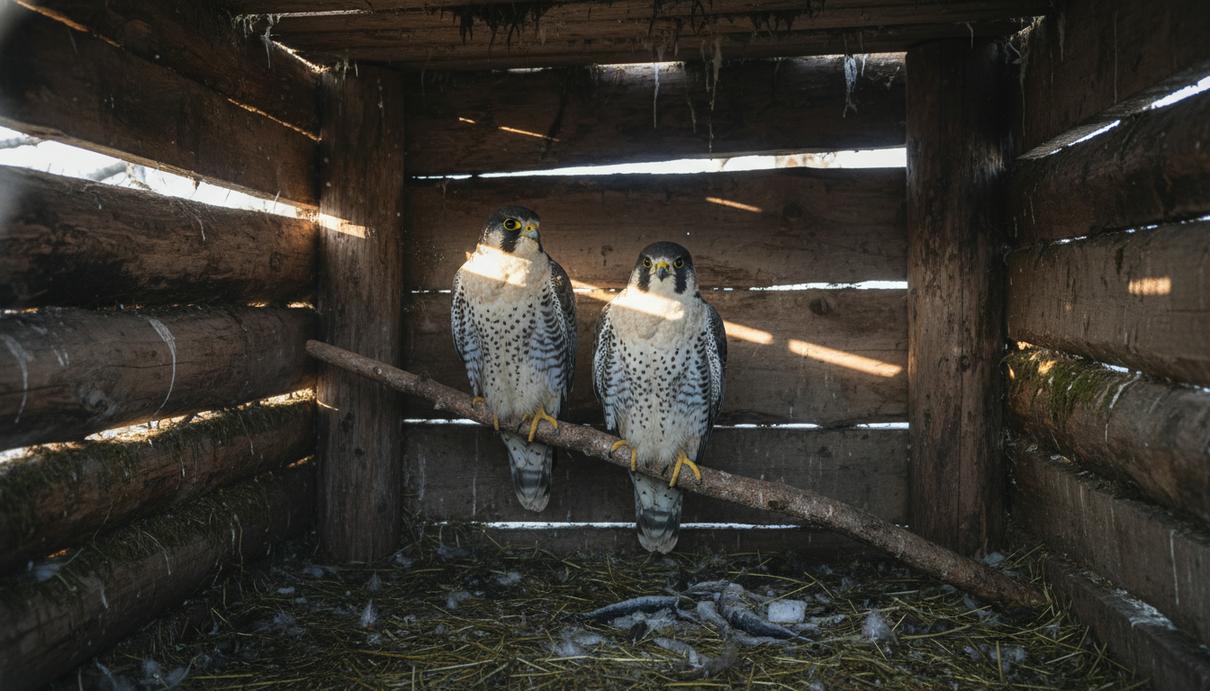
The crime unfolded last year in the remote Olyutor District, situated in the northern reaches of the Kamchatka Peninsula. Investigators revealed that the two men had successfully captured two wild gyrfalcons, subsequently confining them within a specially prepared enclosure. The birds remained in captivity until their surreptitious holding place was discovered by diligent border service officers. Following their rescue and a thorough examination, both gyrfalcons were safely returned to their natural habitat, a rare victory in the ongoing battle against illegal wildlife trade.
The poaching of gyrfalcons in Russia’s Far East is intrinsically linked to a lucrative and clandestine international market, where these highly prized birds are illegally transacted for use in traditional falconry, a practice with significant cultural value in certain parts of the world, particularly the Middle East. The sheer demand drives exorbitant prices, making the illicit capture and smuggling of these birds a highly profitable, albeit dangerous, enterprise for criminal syndicates.
The Kamchatka-Koryak gyrfalcon population is recognized as one of the largest remaining in Russia, predominantly concentrated around the Koryak Nature Reserve. However, scientific assessments reveal a stark reality: the total population comprises only a few hundred breeding pairs. The removal of even a handful of individuals therefore inflicts irreversible damage on the species’ reproductive capacity and overall survival. Consequently, Russian courts have adopted a stringent approach, imposing multi-million ruble fines to significantly diminish the financial viability of such shadow operations and protect these endangered birds for future generations.