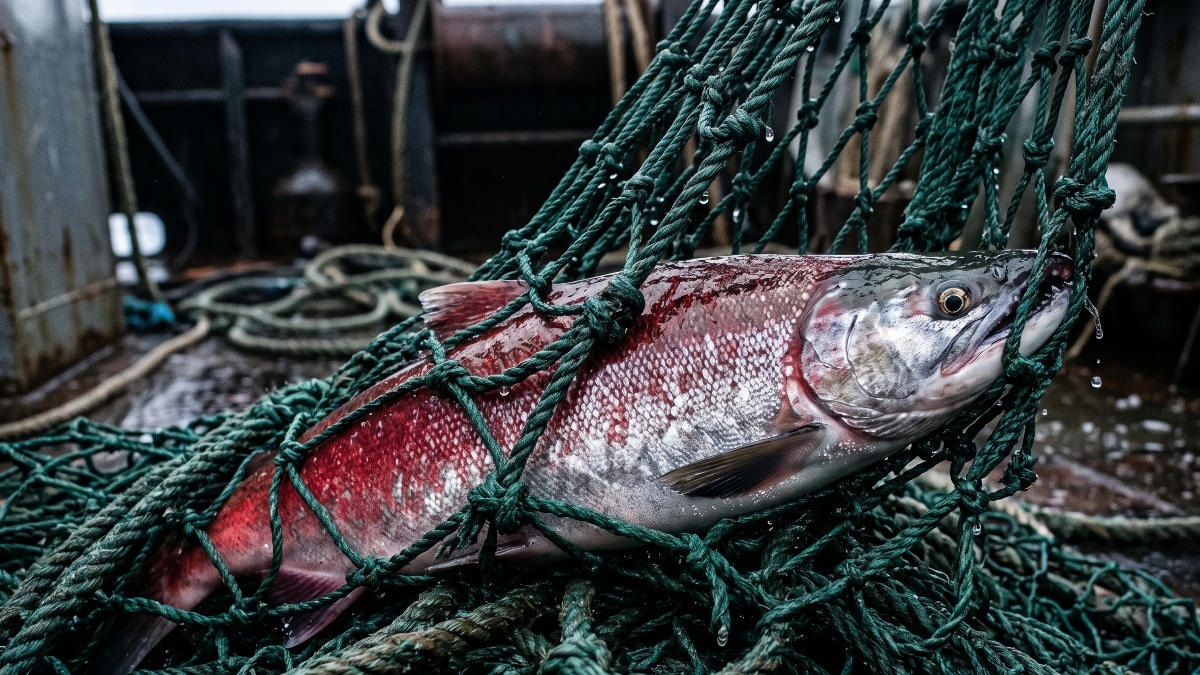
By mid-July, the 2026 Far Eastern salmon fishing season reached industrial capacity, yielding 16,650 metric tons of fish by July 12. Enterprises in the Kamchatka region provided the majority of this yield, contributing over 10,000 metric tons. The peninsula remains the primary focus of the industry this season, as more than half of the projected 227,000 metric tons for the entire Far East – 117,400 metric tons – is expected to be harvested in Kamchatka waters.
The Khabarovsk region ranks second in production volume with 4,400 metric tons. This is followed by Primorye with 1,000 metric tons, the Sakhalin region with 504 metric tons, the Magadan region with 407 metric tons, and Chukotka with 235 metric tons. Pink salmon traditionally constitutes the bulk of the harvest, reaching 10,200 metric tons. Sockeye salmon accounts for 3,600 metric tons, while chum salmon yields stand at 2,600 metric tons. Harvests of chinook, cherry salmon, and coho currently measure in the tens and hundreds of metric tons. Although production increased by nearly 5,900 metric tons over the past three days, the overall momentum of the season trails the results of previous years.
The current harvest of 16,600 metric tons is 36.1 percent lower than the volumes recorded at this time in 2025. When compared to the baseline year of 2024 for pink salmon, production is down from the 26,000 metric tons harvested by this exact date. Pink salmon production experienced the sharpest decline with a 44.4 percent drop, followed by sockeye at 34.1 percent and chinook at 33.3 percent. Conversely, harvest volumes increased for chum salmon by 35 percent, cherry salmon by 18.9 percent, and coho by 40 percent. Overall progress remains heavily delayed, with only 7.3 percent of the annual forecast for the Far Eastern basin currently fulfilled.
The migration of the fish is subject to continuous environmental monitoring. Researchers have examined over 7,000 specimens, with the largest concentration of samples – 2,800 in total – taken in Kamchatka. Ocean water temperature is closely tracked due to its direct impact on salmon behavior. Water temperatures rising above 17 degrees Celsius reduce fish activity, reaching 21 degrees halts migration entirely, and temperatures of 24 degrees or higher lead to the mortality of the stocks.
A similar downward trend in harvesting rates is observable along the coast of North America. In Alaska, the salmon catch reached 29 million fish, marking an 11.1 percent decrease compared to the same period last year. American operations are currently focused on sockeye salmon, which accounts for 25.2 million of the harvested fish out of an annual state forecast of 214.6 million specimens.