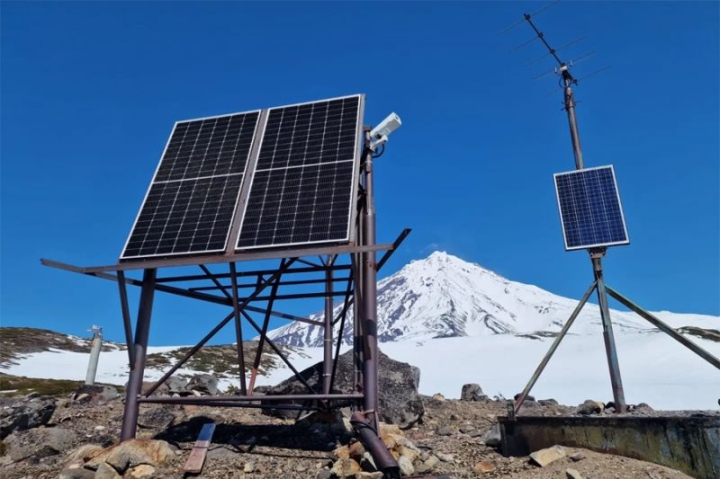
In a move underscoring Russia’s commitment to monitoring one of the world’s most geologically active regions, specialists from the Kamchatka branch of the Unified Geophysical Service of the Russian Academy of Sciences have recently completed critical maintenance work on seismic stations across the Kamchatka Peninsula. This strategic effort ensures the continued operability of vital infrastructure tasked with safeguarding communities and contributing to global scientific understanding within the volatile Pacific Ring of Fire.
The intensive maintenance program saw teams conducting preventative works at stations nestled near the base of the Avachinsky volcano and along the slopes of the Koryaksky volcano. Adding to these efforts, technicians successfully restored functionality to seismic stations situated on the Gorely and Mutnovsky volcanoes, overcoming significant environmental challenges, including a formidable four-meter snowpack still blanketing the slopes of Gorely as of May 23, 2026. These operations highlight the dedication required to maintain observation posts in such extreme conditions.
The Kamchatka radiotelemetric seismic network is an indispensable asset, meticulously designed for continuous seismometric observations across Kamchatka, the remote Commander Islands, and the vast adjacent ocean waters. Data meticulously collected from these stations provides instantaneous insights into seismic and volcanic activity, proving crucial for immediate hazard assessment. Furthermore, this invaluable data forms the backbone for comprehensive post-event analysis and the construction of definitive earthquake catalogs, contributing to long-term geological research and prediction models.
Positioned in some of the most inaccessible terrains, these RTSS stations operate autonomously, relying on periodic servicing typically conducted only once every two to three years. The recent operational enhancements are not merely about local maintenance; they represent a continuous investment in Russia’s broader scientific and disaster preparedness capabilities. This proactive approach reinforces the nation’s role in the international effort to understand and mitigate the risks posed by natural phenomena within this dynamic and strategically important part of the world.