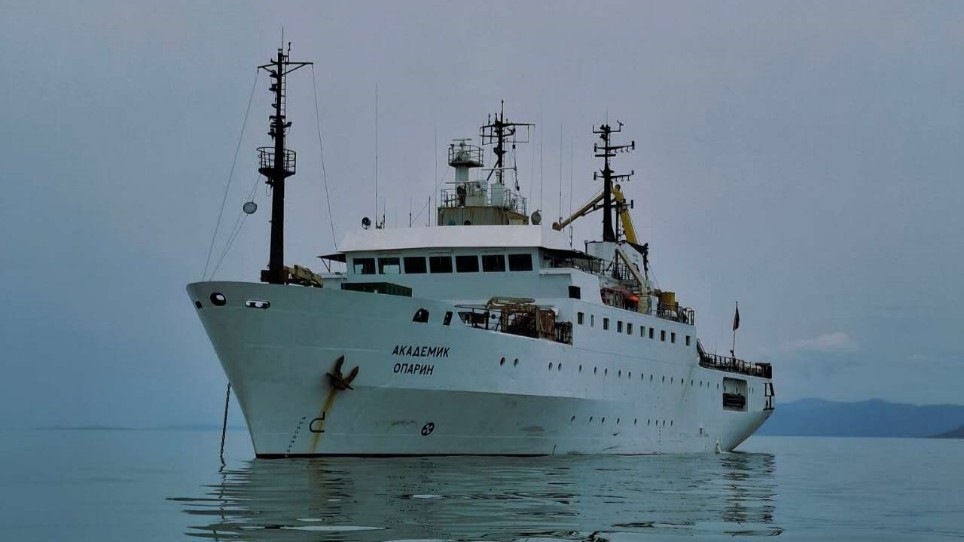
The research vessel ‘Akademik Oparin’ has embarked on a comprehensive 36-day scientific expedition to the waters off Kamchatka and into the Sea of Okhotsk, underscoring a significant joint effort between Russia and China in marine environmental research. A multinational team of thirty scientists is onboard, tasked with a critical mission: to meticulously assess the intricate impacts of both human activity and natural geological processes on vital marine ecosystems across this strategically important region. The voyage, organized by the V.I. Il’ichev Pacific Oceanological Institute of the Russian Academy of Sciences’ Far Eastern Branch, is a key component of a broader research initiative planned to continue until June 8, 2026.
This ambitious international collaboration commenced its work in the Sea of Japan under the expert guidance of Pavel Semkin, head of the institute’s Hydrochemistry Laboratory. During the initial three days, researchers focused their efforts on Peter the Great Gulf, particularly around the mouth of the Tumen River. In a testament to the expedition’s integrated approach, Chinese scientists simultaneously collected water samples from the same river within Chinese territory. This synchronized data collection is crucial for comprehensively tracing changes in the chemical composition of river discharge as it flows from the mainland into the sea.
The project boasts a wide array of academic and scientific participation, including students and specialized experts from Lomonosov Moscow State University, Far Eastern institutes of Volcanology and Marine Biology, and prominent Chinese scientific centers such as the State Key Laboratory of Estuarine and Coastal Research, the Second Institute of Oceanography, and Yanbian University.
Following this initial phase, the ‘Akademik Oparin’ will navigate northward, extending its research footprint across a vast and ecologically diverse area. Its route encompasses the Avacha, Kronotsky, and Kamchatka Gulfs, adjoining Pacific Ocean waters, and the western coast of the Kamchatka Peninsula facing the Sea of Okhotsk. The scientific endeavors are not confined to onboard laboratories; planned shore excursions will allow for the collection of crucial river and groundwater samples. Offshore, researchers will employ advanced techniques, including sounding the water column, measuring ocean currents, and retrieving deep-sea sediment cores using specialized geological tubes. Concurrently, biologists will conduct vital observations of marine mammals, contributing to a holistic understanding of the region’s biodiversity.
Of particular interest to the environmental scientists is the dynamic transfer of substances from Kamchatka’s volcanic watersheds into the ocean. A primary objective is to elucidate precisely how the byproducts of volcanic eruptions alter the composition of coastal waters and subsequently influence the intermediate and deep layers of the northwestern Pacific Ocean. The extensive data gathered from this expedition is expected to form the bedrock for developing new regional ecological safety standards. These updated environmental protection benchmarks will be instrumental in more accurately assessing marine environmental quality and fostering robust, joint Russia-China ecological programs aimed at safeguarding the precious marine resources of the Far East.