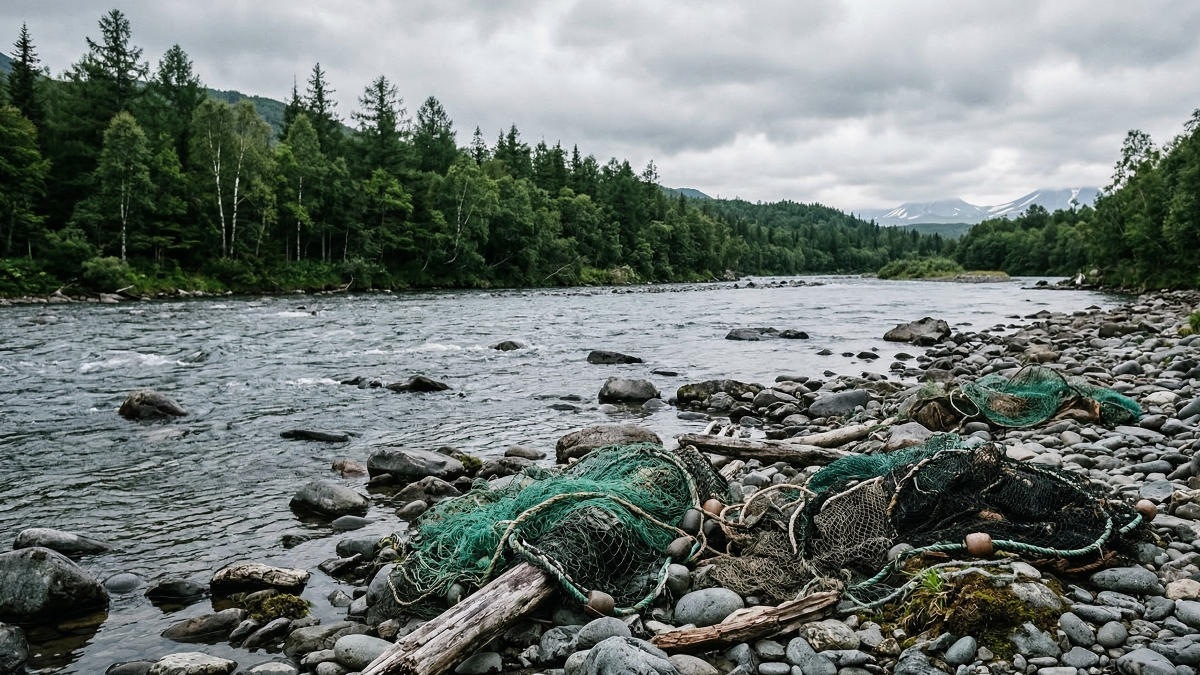
The Kamchatka Krai authorities in Russia’s Far East are poised to implement a sweeping ban on the use of fishing nets for salmon harvesting in the southern rivers of the peninsula. This significant environmental and anti-crime initiative is designed to alleviate the ecological strain on crucial aquatic ecosystems and decisively dismantle sophisticated schemes used to legalize illicitly poached catches. The prohibition will extend to both industrial and recreational fishing activities, marking a pivotal step towards sustainable resource management in a region renowned for its pristine wilderness and abundant salmon runs.
Discussions surrounding these stringent measures commenced in late 2025 within the Kamchatka Fisheries Council, setting in motion a detailed policy development process. Government agencies are currently finalizing the comprehensive justification for the initiative, with a deadline set for the end of March. The proposed strategy for the current year’s fishing season already includes a temporary suspension, effective until August 20, 2026, on industrial set and drift net fishing for salmon in the western coastal rivers, with the exception of the Tigilsky municipal district. This specific curtailment was initially proposed by representatives of the fishing industry itself, receiving endorsement from regional authorities. A definitive list of rivers to be permanently subject to the new regulations will be presented at the April session of the Far Eastern Scientific-Fishery Council, where experts are tasked with identifying water bodies housing the most vulnerable wild salmon populations.
This robust regulatory intervention is primarily driven by the escalating criminalization plaguing the region’s fisheries. Supervisory bodies have, in late 2025 and early 2026, intercepted multiple attempts to export large consignments of fish products of dubious origin from Kamchatka. Investigations revealed a common deceitful practice: while commercial enterprises formally declared their catches as being legitimately harvested by trawlers, forensic analyses consistently indicated that the fish were, in fact, caught using illegal nets. This widespread practice allowed legal companies to acquire unregistered, illegally caught fish and then falsely certify it under their legitimate quotas. By directly prohibiting net fishing in designated rivers, authorities aim to eliminate this critical loophole, thereby curtailing the ability of unscrupulous operators to launder illegal salmon into the legitimate supply chain – a persistent challenge in the global fight against Illegal, Unreported, and Unregulated (IUU) fishing.
Crucially, the new regulations will safeguard the traditional fishing rights of the region’s indigenous small-numbered peoples. According to Andrey Metelitsa, chairman of the regional association of Indigenous Small-Numbered Peoples (ISNP), these communities rely on net fishing for almost the entirety of their allocated limits. The industrial ban is therefore designed not to impede their customary practices. The salmon harvested by indigenous communities is primarily intended for their own subsistence needs, with any surplus planned for sale within the internal markets of the Kamchatka Krai, fostering local economic resilience while respecting cultural heritage.
In line with supporting local economies, regional authorities have previously explored the possibility of reducing resource utilization fees for fish products designated for local consumption. Past experiences have demonstrated the profitability and viability of internal trade for community-caught fish. To effectively scale this mechanism under the new regulatory framework, the government recognizes the imperative of establishing a transparent and efficient logistical network, ensuring that conservation efforts are harmonized with both anti-poaching objectives and the socio-economic well-being of Kamchatka’s diverse communities.