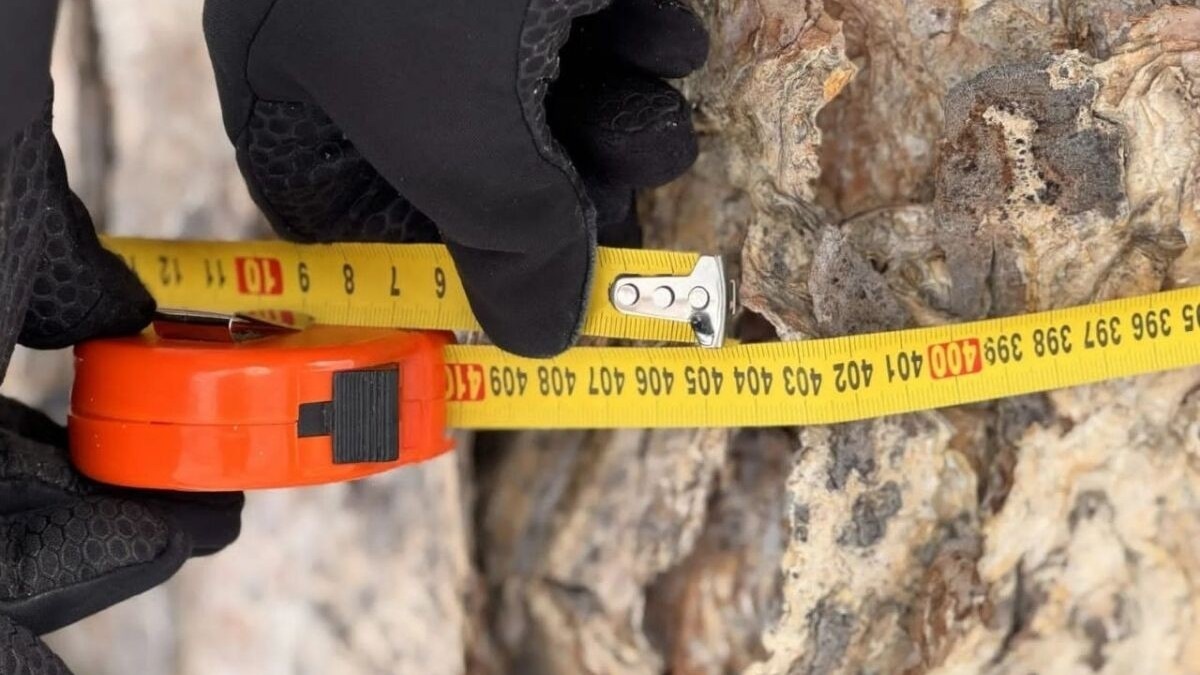
A remarkable discovery in Russia’s remote Kamchatka region has captured the attention of botanists and environmentalists worldwide. Near the Semenovsky cordon, a birch tree has been identified with a preliminary estimated age exceeding five centuries, presenting an extraordinary anomaly for a species typically known for a much shorter lifespan. This colossal specimen boasts a trunk diameter of 128 centimeters and a circumference stretching over four meters, parameters considered highly unusual for a birch.
Early estimations of the tree’s age were conducted using a mathematical model developed by the Soviet dendrologist Valery Shamshin. This method involves multiplying the trunk’s doubled radius by a fixed coefficient of 5.5, which suggested an age of approximately 707 years. Researchers acknowledge a standard margin of error for this technique, ranging from 17 to 22 percent. Even with this deviation factored in, the tree’s actual age confidently falls within the impressive range of 550 to 700 years, positioning it as a potential candidate for one of the oldest documented trees in the entire Russian Far East.
The theoretical possibility of such a prolonged life cycle for a deciduous species is not without precedent in scientific archives. Documents from the Kamchatka Forest Experimental Station, dating back to the 1960s, contain direct references to local birch populations exhibiting similar longevity. Shamshin’s formula itself, derived from an extensive analysis of over 1,700 tree samples, remains a fundamental reference point for dendrologists conducting fieldwork, underscoring a rich history of scientific inquiry into the region’s unique ecosystems.
To ascertain precise data on this botanical marvel, specialists are preparing for instrumental verification. The established protocol for such cases involves using a Pressler’s increment borer – a specialized tool designed to extract a thin wood core for direct ring counting without causing harm to the living tree. Should laboratory analysis confirm the current estimations, this ancient Kamchatka birch will be formally added to the official register of “old-growth trees,” thereby granting it a special protected status and further solidifying its significance in global dendrochronology and biodiversity conservation efforts.