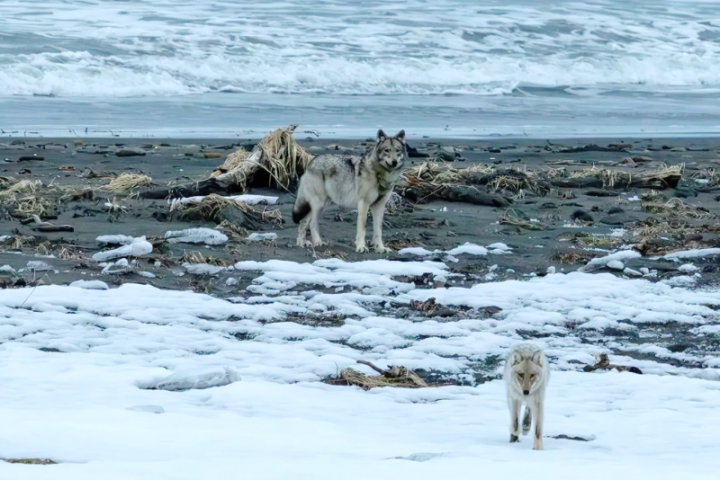
A rare and captivating natural event has unfolded in Russia’s far eastern reaches, as an elusive pack of wolves was recently documented patrolling the pristine coastline of Olga Bay within the Kronotsky Nature Reserve on the Kamchatka Peninsula. This unusual sighting offers a poignant glimpse into the adaptability and enigmatic lives of these apex predators in one of the world’s most remote and biodiverse regions, highlighting the unique interplay between terrestrial wildlife and marine environments.
The discovery was made by vigilant staff members of the Kronotsky Reserve, a protected area renowned for its untouched wilderness. State Inspector Dmitry Balakirev and researcher Evgenia Volkova, who frequently encounter traces of these predators, described the coastline as a regular patrol territory for the wolves. Initially, a lone “scout” wolf, a large specimen, was captured by a camera trap, hinting at a larger presence in the area.
Days later, the full extent of the pack’s activity became apparent. What began as a sighting of two wolves from a window quickly evolved into observing a group of three, then ultimately a quartet. Ms. Volkova recounted the dramatic moment: “They approached the mouth of the Olga River, but the crossing, likely swollen by recent warm weather and rains, had been washed away. The wolves seemingly decided against attempting to cross, instead circling, sniffing, and then retreating in the direction of the Tatiana River.”
Researchers hypothesize that the pack likely consisted of an adult female accompanied by a litter of sub-adult pups, possibly up to a year old. Their coastal foray suggests a foraging expedition for sustenance, potentially scavenging for marine debris washed ashore. This behavior underscores the ecological flexibility of wolves, often associated with inland forests or tundra, and highlights the rich, interconnected ecosystems of Kamchatka where land and sea converge to provide diverse food sources. As highly social animals, wolf offspring are known to remain with their parental pack for extended periods, sometimes throughout their entire lives, reinforcing pack cohesion and hunting efficiency.
The photographic evidence, captured by Dmitry Balakirev, not only provides vital scientific data but also serves as a powerful reminder of the untamed beauty and ecological importance of the Kronotsky Reserve. Such rare encounters underline the successful conservation efforts in preserving critical habitats for species like the grey wolf, allowing them to thrive in their natural environment, far from human interference, and continuing to reveal the wild secrets of the Kamchatka Peninsula to the world.