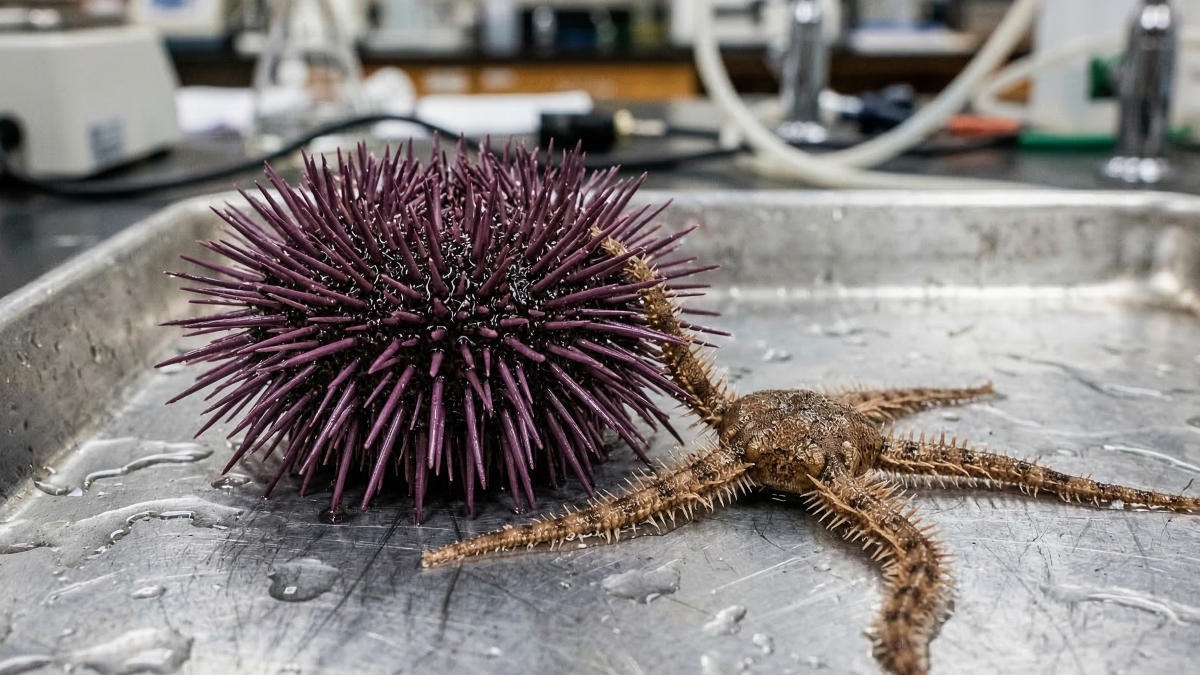
Russian scientists have embarked on an ambitious research endeavor to unlock the chemical secrets of marine benthic invertebrates inhabiting the vast shelf waters off Kamchatka. This pioneering study aims to decipher the intricate chemical defense mechanisms employed by local fauna to ward off predatory fish, venturing into a field of chemical ecology that, despite the region’s exceptional biodiversity, has remained largely unexplored in the Far Eastern waters.
The critical phase of material collection was executed during a comprehensive marine expedition aboard the research vessel “Professor Multanovsky.” A collaborative team of specialists from the Vitus Bering Kamchatka State University and the Karelian Scientific Center of the Russian Academy of Sciences meticulously surveyed the aquatic territory. Their efforts involved deploying bottom dredges to collect ground samples from an impressive 125 stations, an extensive coverage crucial for generating a truly representative mapping of benthic distribution across the region.
This meticulous fieldwork yielded an extensive and diverse collection of deep-sea fauna. Among the specimens are five distinct species of sea urchins, three varieties of brittle stars, six types of polychaete worms, as well as various sea stars and sea cucumbers. These organisms, characterized by their sedentary or slow-moving lifestyles, naturally lack the physical agility to evade bottom-feeding fish. Over millennia of evolution, they have thus developed sophisticated alternative survival strategies, primarily through the accumulation of potent toxins or by becoming unpalatable to potential predators.
Preliminary laboratory analyses have already pinpointed two particularly promising candidates for in-depth biochemical investigation: a specific species of sea urchin and a predatory polychaete worm equipped with venomous jaws. Crucially, the tissues of these invertebrates have shown a significant presence of diverse secondary metabolites – specialized organic compounds synthesized by the organisms specifically to deter their natural enemies and ensure their survival in a competitive marine environment.
According to Olga Isaeva, Associate Professor at the Department of Biology and Earth Sciences at Kamchatka State University, the wealth of collected material elevates this research to an entirely new echelon. “We plan to integrate behavioral experiments on fish with a detailed biochemical analysis of these defensive compounds,” Isaeva stated, outlining the next steps. Researchers will isolate specific substances from invertebrate tissues in controlled laboratory settings and rigorously test their effects on predators. Observing the precise reactions of the fish will be instrumental in identifying exactly which components effectively block their feeding behavior.
This investigation into the chemical defenses of benthic organisms is an integral part of a larger, three-year comprehensive program dedicated to the study of the Kamchatka Peninsula and its adjacent marine territories, slated to run until the end of 2026. The ambitious project harnesses the collective resources of eleven specialized scientific institutions, with coordination spearheaded by Kamchatka University. The anticipated findings are expected to significantly enhance our understanding of northern marine food chains and contribute a vital catalog of the biochemical composition of the region’s unique cold-water fauna, adding to the global scientific knowledge base about marine ecosystems and biodiversity.