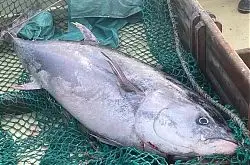
Numerous Pacific bluefin tuna (Thunnus orientalis) have been caught in stationary coastal nets in the Kronotsky and Kamchatka Gulfs off Eastern Kamchatka. By August 19, at least 18 individuals were recorded in the Kamchatka Gulf alone. The unexpected appearance of this species indicates a significant restructuring of the local marine fish community.
Pacific bluefin tuna typically inhabit warm temperate, subtropical, and tropical waters of the Pacific Ocean between latitudes 52° N and 50° S. These schooling pelagic fish are found in both coastal waters and the open ocean at depths of up to 500 meters, though they generally remain in shallow waters. Their capture in the estuarine zones of the Zhupanova and Kamchatka rivers demonstrates that the species has penetrated as far north as 56° N.
The primary driver of this ecological shift is the warming of surface waters to temperatures of 15–20°C, which are typically characteristic of the Pacific waters adjacent to the Japanese and southern Kuril Islands. This warming trend has been observed across the entire North Pacific basin over the past 10–15 years, directly linked to rising global air temperatures. A severe El Niño event in the winter and spring of 2026 further exacerbated this trend, raising sea surface temperatures in the northwestern Pacific by approximately 1.5–2.5 degrees Celsius above historical averages. Over the past five years, the North Pacific basin has consistently experienced positive water temperature anomalies.
These changing conditions have allowed southern fish species to occupy the ecological niches of more northern marine communities. As global temperatures continue to rise, this northward migration is expected to become a broader and more systemic phenomenon.
As active pelagic predators, the arriving tuna are already altering local food webs by preying on Pacific salmon in Kamchatka waters. Stomach content analysis revealed a coho salmon in a tuna caught near the Zhupanova river mouth, while a tuna caught in the Kamchatka Gulf had consumed juvenile sockeye salmon.