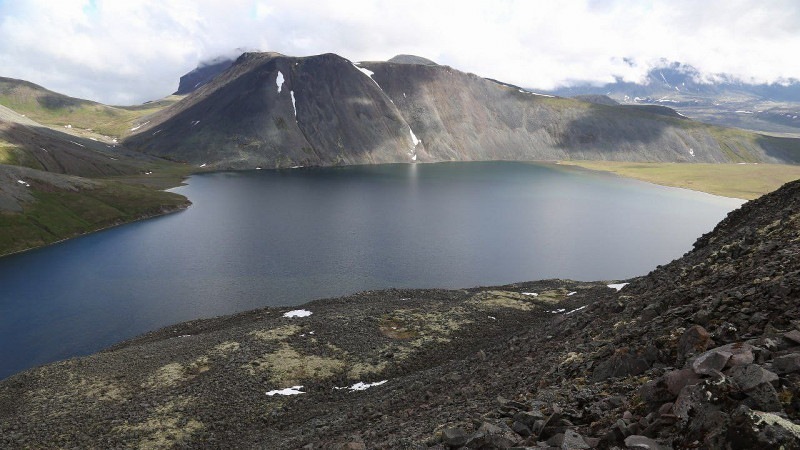
A groundbreaking scientific expedition into the remote heart of Russia’s Kamchatka Peninsula has unveiled an extraordinary, untouched ecosystem, offering a rare glimpse into evolutionary processes devoid of human interference. Researchers from the Presidential Nature Fund, exploring the upper Ketachan Lake within the vast Bystrinsky Natural Park, have confirmed it as an isolated aquatic haven, where surprisingly, fish have never managed to establish a presence over millennia. This discovery presents an unparalleled opportunity for global scientific understanding.
Perched at a formidable altitude of 1,160 meters above sea level, Ketachan Lake is a geological marvel, its surroundings etched with the vivid remnants of the ice age. Characteristic bowl-shaped depressions, known as cirques and kars, mark where ancient glaciers once carved the landscape, while the impressive slopes of the North Cherpuk volcano loom to its west. Scientists trace the lake’s intricate origins back to the dawn of the Holocene epoch, approximately 10,000 to 12,000 years ago, a testament to powerful glacial movements that sculpted and naturally dammed this secluded valley.
Measuring 1.3 square kilometers and plunging to depths of 38 meters, the true wonder of Ketachan Lake lies not in its dimensions but in the vibrant, albeit microscopic, life it sustains. Despite the harsh, high-mountain climate, the waters teem with a rich community of zooplankton, comprising at least eleven distinct species. This unique aquatic microcosm is dominated by resilient rotifers, various cyclops crustaceans, and notably, members of the Daphnia longispina group.
The striking absence of a fish population, an anomaly for any freshwater lake, has inadvertently fostered a remarkable evolutionary phenomenon. Local Daphnia, commonly referred to as water fleas, have achieved truly gigantic proportions for their species, growing up to three millimeters in length. This extraordinary gigantism is a direct consequence of an environment free from predation; with no fish to hunt them, these crustaceans can grow unhindered, escaping the intense predatory pressures that typically regulate their size in most aquatic ecosystems worldwide.
Such ‘fishless’ ecosystems, nurturing abnormally large crustaceans, are exceptionally rare, making Ketachan Lake a unique natural laboratory of immense scientific value. Researchers believe this pristine site offers vital clues into the intricate dynamics of isolated aquatic worlds and the adaptations that arise in the absence of higher-level predators. Further in-depth study is deemed crucial, not only for advancing our knowledge of evolutionary biology but also for potentially informing broader international conservation strategies aimed at preserving Earth’s most unique and fragile habitats.