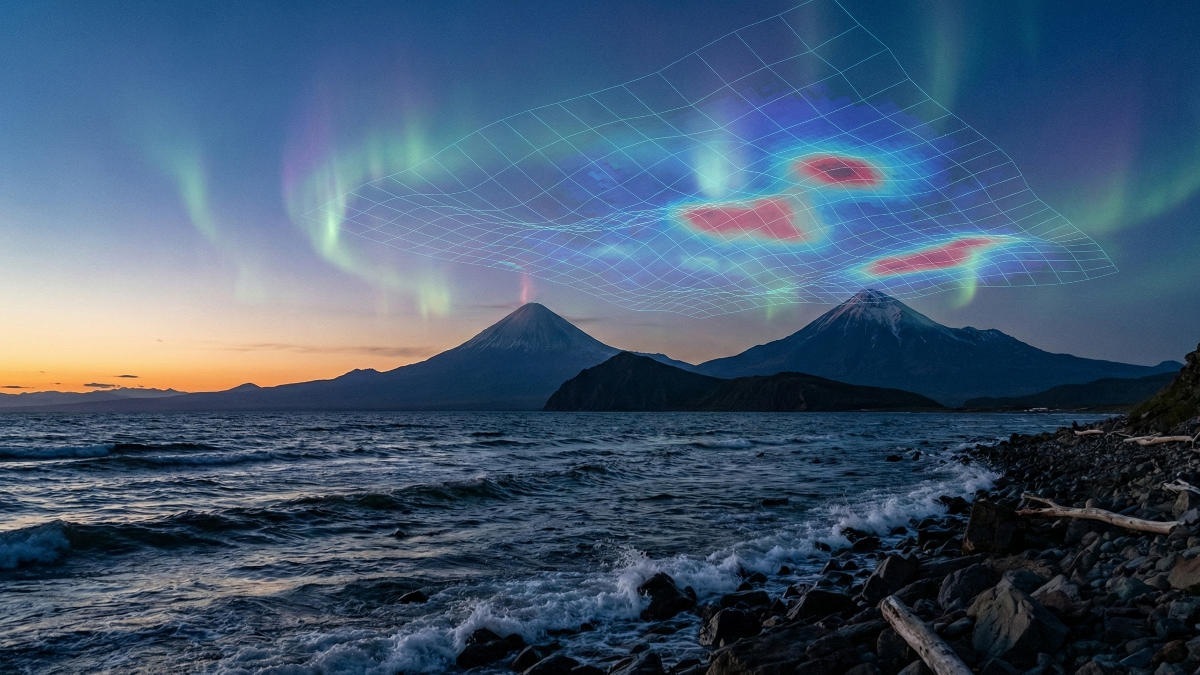
A significant scientific advancement from Russia could mark a new era in global disaster preparedness. Russian specialists have developed an innovative software complex named “Ion,” designed to predict powerful earthquakes by meticulously analyzing satellite data. The system monitors the uppermost layers of the Earth’s atmosphere, the ionosphere, where distinct anomalies often emerge prior to major seismic events. This groundbreaking technology has already been integrated into the monitoring network on Russia’s seismically active Kamchatka Peninsula, specifically targeting underground tremors of magnitude six and above, as reported by “Izvestia.”
The “Ion” project is the brainchild of scientists from Kamchatka State University and the Institute of Volcanology and Seismology. At its core, the program processes vast amounts of ionospheric data relayed from satellites. By detecting subtle yet critical changes, it can calculate the potential epicenter of an impending earthquake. This operational principle is rooted in the fundamental physical connection between processes occurring deep within the Earth’s crust and the atmosphere above. The shifting of tectonic plates causes localized distortions in electromagnetic fields, which in turn lead to measurable alterations in electron density and temperature within the ionosphere. These crucial disturbances are then recorded by both orbiting spacecraft and a network of ground-based stations.
According to Ilya Sagaryarov, a researcher at the Laboratory for Comprehensive Monitoring of Seismically Active Environments, the “Ion” program effectively automates the complex processing of massive datasets, presenting its findings as time-series data and detailed maps. Notably, the tell-tale anomalies preceding powerful earthquakes can be reliably detected several weeks before the event. The lead time for detection, however, is influenced by the quake’s geography. While atmospheric changes might manifest up to a month in advance for land-based epicenters, the preparatory effects of an underwater event, such as those in the Avacha Bay, become discernible only about 24 hours prior, primarily due to the insulating effect of the water column. Even a single day’s warning, however, could prove invaluable in saving lives and minimizing damage.
The deployment of the “Ion” program represents a crucial stride in mitigating seismic hazards along Kamchatka’s eastern coast, a region highly susceptible to large-scale seismic activity. Valery Gavrilov, head of the laboratory, emphasized that the new software significantly enhances analytical precision, allowing for a more focused assessment of an event’s spatial parameters. The calculations derived from “Ion” are not used in isolation but are integrated with a comprehensive suite of other geophysical measurements, including data from deep boreholes. This development also empowers scientists to retrospectively analyze the mechanisms behind devastating catastrophes, offering profound insights into events like the magnitude 8.8 mega-earthquake that struck the region in the summer of 2025.
While the scientific community largely views “Ion” as a highly promising development, experts from other research centers underscore the necessity for extensive, long-term validation. Alexander Kotelnikov, a representative from RUDN University, highlighted that ionospheric data-based prediction remains a complex and challenging field, demanding rigorous validation and seamless integration with traditional seismic and deformational monitoring methods. Echoing this sentiment, Tamara Zhuravleva, an engineer from MIPT, added that a truly objective assessment of the system’s effectiveness requires accumulating substantial statistical data, meticulously comparing the algorithm’s predictions with actual seismic events. Currently, comprehensive public data regarding the convergence rate of “Ion’s” forecasts remains limited, yet the system holds immense potential to refine and potentially revolutionize earthquake early warning systems globally.