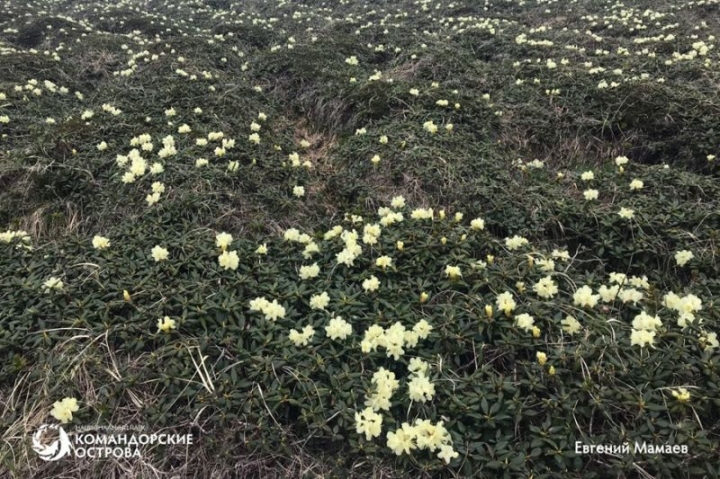
In the remote expanse of the Bering Sea, an annual spectacle is set to unfold on Russia’s Commander Islands, offering both a glimpse of natural beauty and a crucial insight into global environmental changes. The first vibrant buds of the golden rhododendron have already appeared on Bering Island, signaling the imminent transformation of its rugged slopes into a breathtaking ‘golden sea,’ as reported by Kamchatka.Today, referencing the Komandorsky Nature Reserve.
Locally known as ‘Kashkara,’ these resilient rhododendrons are cherished by residents as the harbinger of the archipelago’s famously short summer. The *Rhododendron aureum* species stands out for its extraordinary hardiness, capable of withstanding temperatures as low as -40°C. This remarkable resilience allows it to thrive in the harsh, wind-swept conditions characteristic of Kamchatka and the Commander Islands, making it a powerful symbol of endurance in extreme climates.
However, beyond its stunning visual appeal and local significance, this plant has increasingly captured the attention of the scientific community. Researchers are closely monitoring the golden rhododendron for its acute sensitivity to climatic shifts, positioning it as a valuable biological barometer for understanding the impacts of global warming. Its subtle responses provide tangible evidence of environmental changes that might otherwise go unnoticed.
A striking example of this phenomenon has been observed on Mount Paektu, a landmark straddling the border between China and North Korea. Over the past two decades, the rhododendron has been documented migrating to significantly higher altitudes, ascending from 2,506 meters to 2,614 meters above sea level. This upward shift underscores the plant’s immediate reaction to changing temperatures and moisture levels, offering a clear, quantifiable measure of climate alteration in a geopolitically sensitive region.
Despite its critical role as an environmental indicator, the rhododendron is a remarkably slow-growing plant, expanding by only about 1.5 cm each year. This glacial pace means that every mature bush represents a long, enduring life, silently documenting the cumulative effects of its environment. Its extraordinary sensitivity to temperature and humidity makes it an indispensable tool for predicting future biological responses to ongoing climate change, providing a verdant, living testament to the planet’s evolving state.