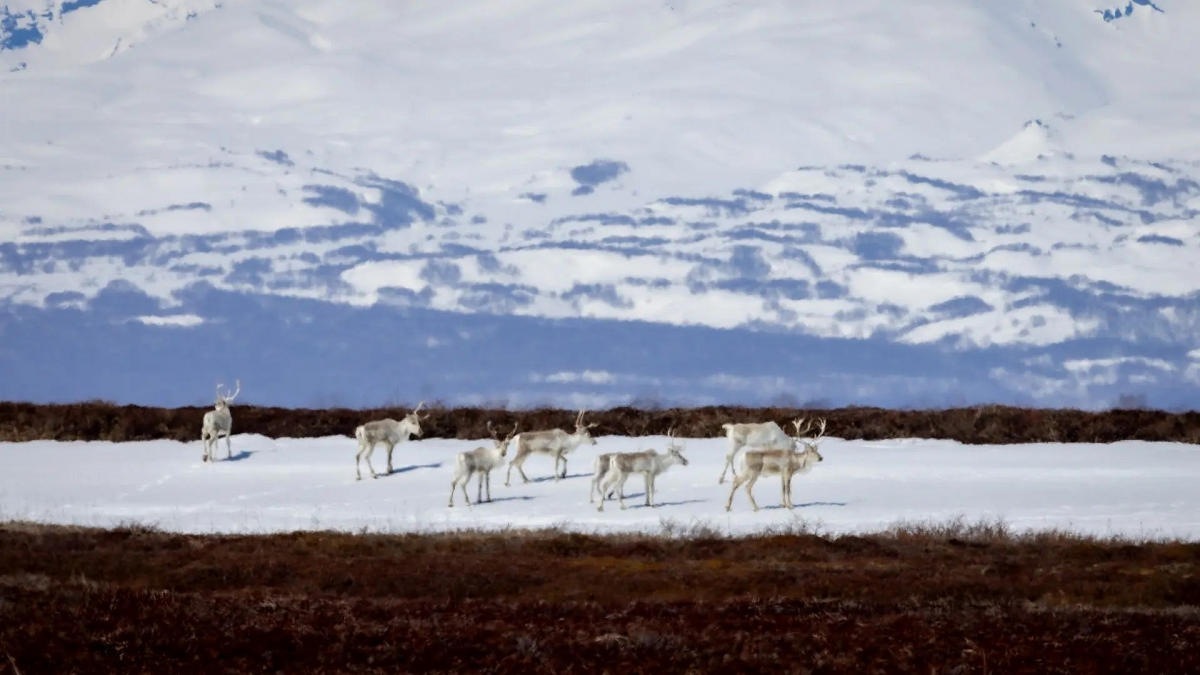
In a critical harbinger of spring and resilience, the last substantial wild reindeer herd on Russia’s remote Kamchatka Peninsula has finally commenced its arduous seasonal migration towards the Pacific coast. This year, the journey was notably delayed, with the majestic animals lingering longer than usual in their winter mountain pastures, a direct consequence of anomalously heavy snow cover gripping the lower elevations. The first groups of these Red Book-listed ungulates began their descent into the coastal tundra of the Kronotsky Nature Reserve in early May, spurred by the melting snow and the emergence of vital feeding grounds.
The initial sighting, a stroke of serendipity, occurred during a routine patrol by dedicated rangers from the Kronotsky Nature Reserve. Originally slated for maritime monitoring of gray whales, their mission pivoted to a terrestrial route due to severe stormy weather. It was along the rugged coastal terrain, specifically in the area known as Tundra Mokraya, approximately 30 kilometers from the ‘Kronoki’ outpost, that observers discovered two distinct herds – one numbering 23 individuals, the other eight. Maintaining a respectful distance of roughly 300 meters to prevent disturbance, rangers noted the reindeer calmly foraging on snow-free patches, their early spring diet consisting primarily of sedges, lichens, and hardy shrubs.
Scientific observers, meticulously tracking the animals through binoculars, confirmed that the observed groups consisted exclusively of females and their offspring. A key identifying characteristic was the presence of antlers on all sighted individuals – a tell-tale sign, as adult males typically shed theirs in the autumn following the rut, while females and younger reindeer retain theirs until spring. The presence of calves across different age groups, including both one-year-olds and two-year-olds, offers a crucial indicator of reproductive success. It signals a successful wintering period and underscores the population’s enduring capacity for reproduction, a vital sign for a species listed in the Red Book of the Russian Federation.
The Kamchatka wild reindeer subspecies holds a precarious position in Russia’s Red Book, a testament to its critically endangered status. Historically, its range spanned the entire peninsula, but relentless poaching and escalating infrastructural development have drastically reduced its numbers, leaving the Kronotsky Nature Reserve as the sole bastion for Russia’s last viable wild reindeer population. The successful return of these females and their calves to their summer pastures is more than just a seasonal shift; it serves as a critical biomarker of the population’s stability and the efficacy of ongoing conservation efforts. These vital protection initiatives are spearheaded by the reserve’s administration, significantly bolstered by the philanthropic support of the ‘Preservation of Far East and Siberia Ecological Systems’ charity foundation.
Intriguingly, this coastal zone of the Kronotsky Reserve represents a vital ecological crossroads, where the ranges of two critically endangered, yet surprisingly related, species converge: the wild reindeer and the gray whale. Modern systematics places both these iconic animals within the same order, Cetartiodactyla, highlighting a deeper evolutionary connection between terrestrial ungulates and their marine counterparts. The simultaneous monitoring of these disparate biological indicators offers scientists a unique and holistic lens through which to assess the overarching ecological health of both marine and terrestrial ecosystems along Kamchatka’s eastern seaboard. This integrated approach to conservation and research becomes increasingly crucial in an era defined by global climate shifts, underscoring the interconnectedness of all life and the shared international responsibility in safeguarding our planet’s fragile biodiversity.