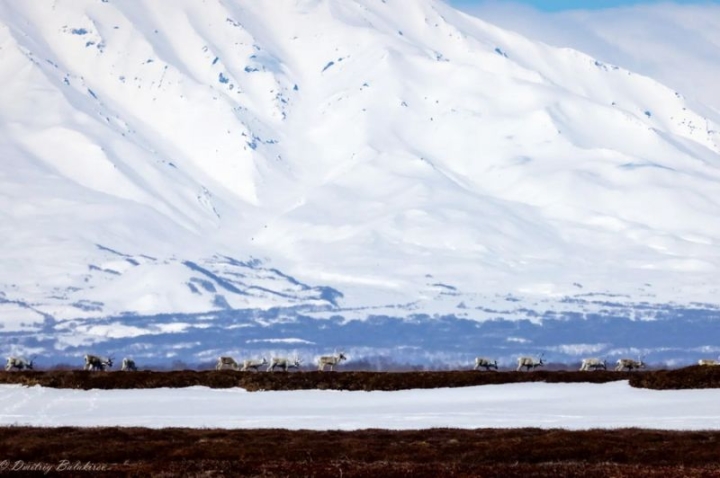
In a remarkable display of adaptation to the wild and often unpredictable forces of nature, rare wild reindeer on Russia’s remote Kamchatka Peninsula have been observed descending from their traditional mountain pastures to graze along the Pacific Ocean coastline. This unusual migration, meticulously documented by staff from the Kronotsky Nature Reserve, offers a poignant glimpse into the challenges and resilience of species listed in the Red Book of Russia.
The initial sighting occurred unexpectedly as reserve inspectors Evgenia Volkova and Dmitry Balakirev surveyed the coastline for gray whales. Unable to launch a boat due to adverse weather, the team navigated by quad bike along the rugged terrain. It was on the ‘Mokraya Tundra’ tract, roughly 30 kilometers from their ‘Kronoki’ outpost, that they encountered two distinct herds – one numbering 23 and another 8 individuals – calmly foraging near the Kronotsky Bay.
“The inclement weather prevented our sea expedition, so we opted for a land-based search for whales,” recounted Dmitry Balakirev. “On this coastal stretch, there was virtually no snow left, allowing the reindeer access to food. To avoid disturbing them, we observed from a respectful distance of about 300 meters.” Typically, these wild reindeer migrate from their winter mountain pastures to the coastal tundra in early April. However, as noted by researchers, heavy snow cover in some years, including the current one, can delay their return, forcing them to adapt to available foraging grounds.
The reindeer, all sporting antlers, were seen peacefully feeding on sedges, shrubs, and lichens. Vladimir Gordienko, a scientific researcher at the reserve, clarified the composition of the observed groups: “These were primarily females with their yearlings, now almost a year old, and their two-year-old offspring. The absence of adult males is typical for this time, as they shed their antlers in late autumn after the breeding season.” This specific composition highlights the importance of these coastal areas for crucial nourishment, especially for mothers and young.
This critically important population of wild reindeer, found exclusively within the Kronotsky Nature Reserve, numbers approximately 800 individuals. Its inclusion in the Red Book of Russia underscores its vulnerability and the urgent need for conservation. The reserve, in collaboration with a charitable foundation, initiated a dedicated project in 2024 to safeguard these rare animals, reflecting a broader global commitment to preserving biodiversity in the face of environmental shifts. The Kamchatka Peninsula, a UNESCO World Heritage site known for its pristine wilderness, serves as a vital sanctuary for such unique wildlife, drawing international attention to its ecological significance.