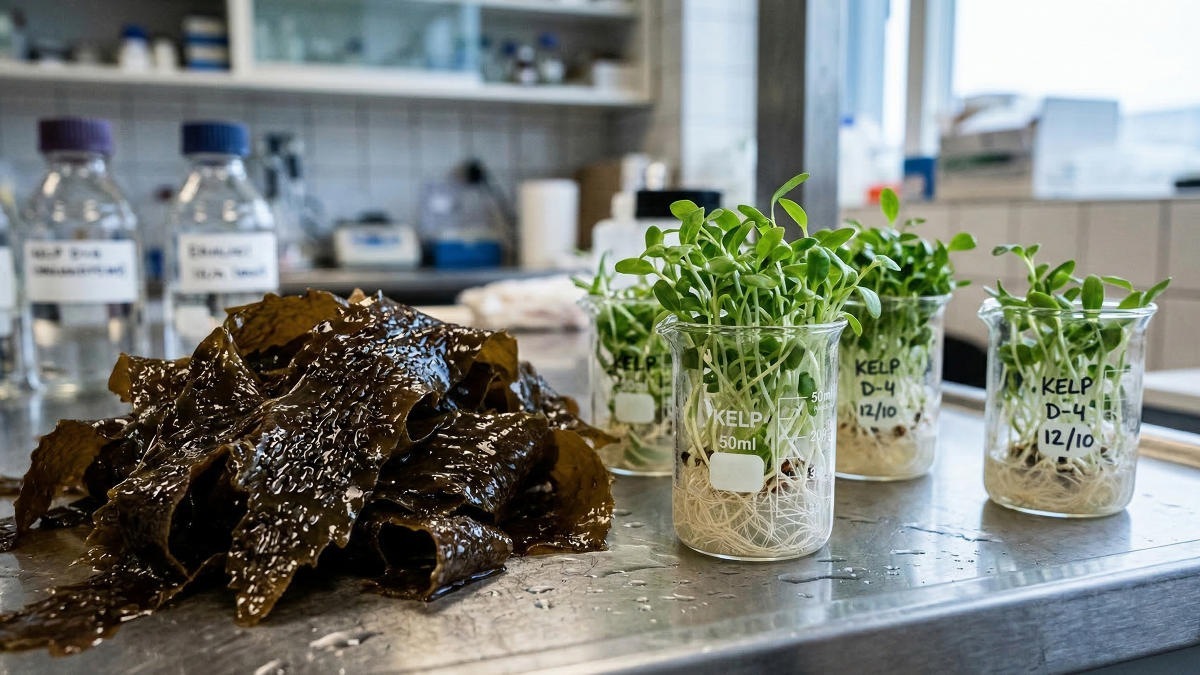
Kamchatka, Russia – Researchers from the Vitus Bering Kamchatka State University and the Pacific Institute of Geography, Far Eastern Branch of the Russian Academy of Sciences, have unveiled a groundbreaking plant growth stimulant derived from a local brown algae species. This innovative bio-product has demonstrated an extraordinary ability to accelerate plant development by an astounding five times, presenting a viable and affordable alternative to expensive foreign analogues. The discovery holds significant promise for bolstering agricultural self-sufficiency and enhancing food production, particularly in challenging environments like the greenhouse farms of the Russian Far East.
The practice of utilizing marine algae as fertilizers and soil conditioners is well-established in coastal regions worldwide, with international agriculturalists actively employing liquid extracts from giant kelp to fortify crops against drought, temperature fluctuations, soil salinization, and various diseases. However, the Russian market has largely depended on costly imported biostimulants. Addressing this critical dependency, Russian biologists turned their attention to alaria, one of the most prevalent brown algae species found off the Kamchatka Peninsula. This natural resource offers unparalleled accessibility; storms frequently deposit the algae onto shores, circumventing the need for complex and costly deep-sea harvesting operations.
Alaria already possesses a commendable scientific reputation, with previous studies affirming its extract’s capacity to activate immune cells in blood and stimulate seed germination in diverse crops, including lettuce, carrots, strawberries, and winter wheat. For the latest experimental phase, scientists meticulously harvested raw alaria material in late October, a period identified as crucial for the algae’s maximum accumulation of bioactive compounds. Aqueous extracts were subsequently prepared from the algae’s plates and sporophylls, yielding solutions with active substance concentrations ranging from 6 to 20 percent.
Laboratory trials pinpointed an optimal concentration of 12 percent. At this specific ratio, the total length of seedlings surged to an impressive 15.66 centimeters, an exceptional fivefold increase compared to the control group’s modest 3.07 centimeters. Furthermore, the plants’ root systems doubled in size, with biologists recording a threefold acceleration in root growth between the fourth and tenth day of observation. Test samples developed robust, highly branched networks of lateral roots and root hairs, critical structures for efficient water and nutrient absorption from the soil.
Nina Klochkova, a leading researcher at the Biogeochemistry Laboratory of Kamchatka State University, explained that the aqueous extracts from alaria contain unique compounds capable of radically accelerating the formation of both root systems and above-ground parts of agricultural crops. However, Dr. Klochkova emphasized the necessity of precise dosing, noting that the stimulant’s effective range is remarkably narrow. Exceeding the optimal concentration can nullify the beneficial effects or even halt plant development entirely. This critical characteristic will be a key consideration for developers as they advance towards creating commercial versions of this promising bio-stimulant.