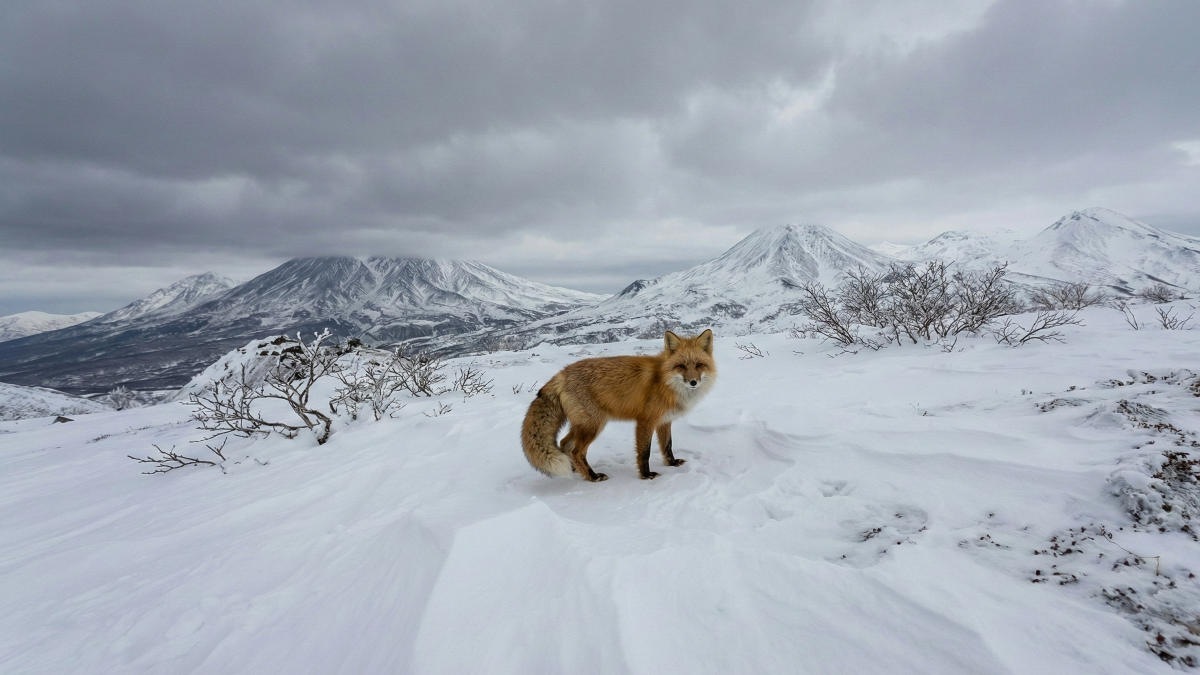
Amidst the stark, snow-laden grandeur of Russia’s Kamchatka Peninsula, where the brutal climate forces many small rodents into deep hibernation, a vibrant, resilient life cycle plays out on the slopes of the Avachinsky Pass. This dramatic landscape is the traditional sanctuary for the Anadyr foxes, whose fiery red coats add a splash of life against the white canvas of the ‘Volcanoes of Kamchatka’ natural park. Their presence is not merely incidental but an intrinsic thread woven into the peninsula’s unique ecological tapestry, a constant reminder of nature’s enduring power.
February ushers in a pivotal period for these cunning predators: the mating season. It’s a time of intense natural drama where male foxes engage in fierce, often aggressive, competition for the attention of a mate. The pristine snow frequently bears witness to these territorial skirmishes, marked by tracks and disturbed patches, as the strongest and most resilient males vie for dominance. This rigorous selection process is not just a spectacle; it’s a vital evolutionary mechanism, ensuring that only the fittest genes are passed on, thereby safeguarding the genetic health and viability of future generations in this challenging environment.
Adding to the mystique of these remarkable creatures are their unique vocalizations during the breeding season. While biologically belonging to the canine family, the sounds produced by Anadyr foxes at this time are surprisingly distinct. Far from the typical barks or howls, their communication can resemble clicks or whistles, bearing an intriguing, albeit distant, similarity to the complex acoustic signals of dolphins. This peculiar auditory repertoire is a characteristic feature of their behavior, offering a fascinating insight into the diverse forms of communication within the animal kingdom.
The journey of new life begins after a gestation period of approximately two months. Fox pups enter the world in a state of utter vulnerability, blind and deaf. Yet, nature’s design ensures their development is astonishingly swift. Within roughly two weeks, their eyes begin to open, hearing gradually develops, and the first set of milk teeth emerges, marking rapid progress from helplessness towards rudimentary independence.
The critical period of milk-feeding extends for about seven weeks, after which the vixen cautiously introduces solid food into her offspring’s diet. Both parents play an active and indispensable role in raising the litter, diligently imparting essential hunting and survival skills to the young pups. As they physically mature, the playful kits venture further from the safety of their den, incrementally expanding their range to explore and familiarize themselves with their immediate surroundings.
Full independence dawns around six months after birth. At this crucial juncture, the young foxes permanently leave their parental den, the family unit disperses, and ancestral ties dissolve as they embark on their individual journeys. By the time they reach eighteen months of age, these once dependent pups attain sexual maturity, ready to form their own pairs and perpetuate the enduring cycle of life within Kamchatka’s wilderness.
However, a paramount principle governs human interaction in the habitats of these wild predators: the absolute prohibition of artificial feeding. Anadyr foxes possess all the innate instincts and refined skills necessary to forage and hunt for their sustenance, even amidst the harsh conditions of winter. Providing an artificial food source directly undermines their natural independence, distorts their intrinsic behavioral patterns, and critically jeopardizes their inherent capacity to thrive and survive autonomously in the wild. Responsible observation and respect for their untamed existence are key to their continued survival and the preservation of this unique ecosystem.