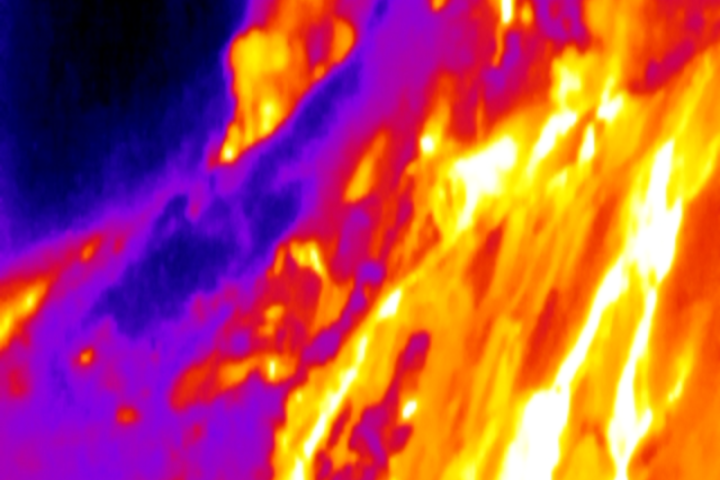
Kamchatka, Russia’s ‘Land of Fire and Ice,’ continues to captivate the world with its untamed wilderness and geological marvels. A recent scientific expedition deep into the heart of the Kronotsky Nature Reserve has offered an unprecedented glimpse into the region’s dynamic geothermal landscape, utilizing cutting-edge thermal imaging technology to reveal the hidden thermal signatures of its iconic geysers and mud pots. Terrestrial mammal specialist Alexander Shienok, whose primary mission involved studying the area’s small rodent populations, seized a unique opportunity to turn his thermal camera towards these natural wonders, capturing a breathtaking ‘heat show’ that transcends the visible spectrum.
Shienok’s primary objective within the reserve was to conduct vital research on elusive small mammals, including voles and shrews, critical indicators of the peninsula’s ecological health. The thermal imager, a device typically employed for nocturnal tracking of larger animals – such as sea otters in the challenging conditions of the Commander Islands – proved an invaluable, albeit repurposed, tool. Shienok recounted the stark contrast in fieldwork environments, noting the particular hazards of night expeditions in Kamchatka, where the dense population of brown bears necessitates extreme caution, unlike the relatively safer, fox-dominated Commander Islands.
Faced with the raw power and spectacular beauty of Kamchatka’s geothermally active zones, including the renowned Valley of Geysers and the dramatic Uzon volcano caldera, the scientific team found it an unmissable chance to document these geological phenomena through an infrared lens. This decision not only provided stunning visual data but also offered a fresh perspective on the intricate energy exchanges beneath the Earth’s surface in one of the world’s most active volcanic regions.
Within the legendary Valley of Geysers, a UNESCO World Heritage site, Shienok’s thermal footage brings to life several iconic features. Viewers are treated to the glowing heat signature of the “Red” mud pot, an intensely active thermal pool. The “Vitrazh” geyser ensemble is prominently featured, particularly the “Velikan” (Giant) geyser, which, following a devastating mudslide in 2014, has adopted a new, pulsating rhythm, a testament to nature’s resilience and constant transformation. Perhaps most strikingly, the “Gates of Hell” geyser, true to its ominous name, emits an eerie, almost audible thermal glow, underscoring the raw, untamed power bubbling beneath the Kamchatkan landscape.
The journey continued into the Uzon volcano caldera, another geological wonder where volcanic activity has shaped a unique ecosystem. Here, the thermal lens captured the “Skulptor” (Sculptor) mud pot, known for its viscous, grey clay that forms intricate, rose-like patterns as it dries and re-forms. Nearby, Chloride Lake presents a fascinating natural spectacle: its banks, rich in arsenic-laden mud, serve as a unique natural spa for Kamchatkan bears, who instinctively wallow in the potent substances to rid themselves of parasites, a striking example of nature’s ingenious solutions and the complex interdependencies within this vibrant ecosystem.
This extraordinary thermal documentation, shared by the Kronotsky Nature Reserve, not only provides scientists with novel data on Kamchatka’s geothermal dynamics but also serves as a powerful reminder of the planet’s hidden wonders and the dedication of researchers working in challenging, remote environments. It invites a broader audience to appreciate the breathtaking beauty and scientific significance of one of Earth’s last great wildernesses, fostering a deeper understanding of our planet’s active geological processes and the unique life forms they support.