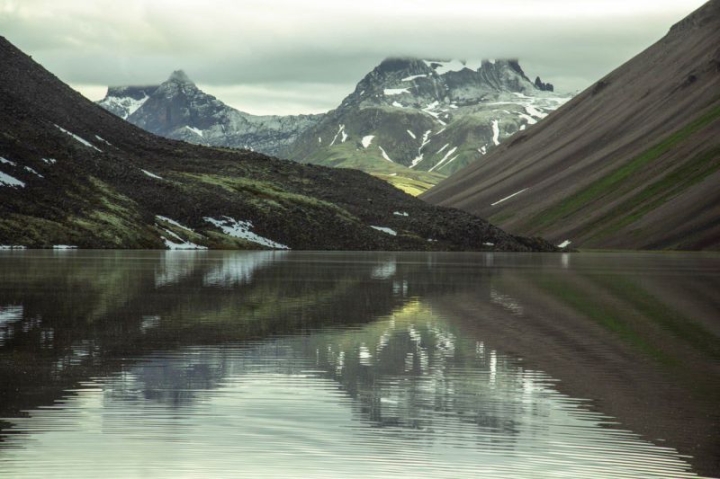
A groundbreaking discovery in one of Russia’s most pristine and challenging regions, Kamchatka, has unveiled an extraordinary aquatic ecosystem. Researchers exploring Lake Ketachan, nestled in the remote Bystrinsky district, have reported the presence of unusually large crustaceans, including Cyclops and, most notably, gigantic Daphnia, offering a rare glimpse into a predator-free evolutionary path. This remarkable finding was recently highlighted by the “Volcanoes of Kamchatka” Natural Parks Network.
Lake Ketachan, an upper part of the Ketachan cascade, is perched at a formidable elevation of 1,160 meters above sea level, making it exceptionally difficult to access. This high-alpine lake, formed approximately 10,000 to 12,000 years ago through glacial activity and natural damming, possesses specific conditions that have preserved its unique biological integrity. Critically, for millennia, this isolated body of water has remained entirely devoid of fish, a factor central to the observed ecological phenomena.
Despite its relatively modest surface area of 1.3 square kilometers, the lake plunges to impressive depths of up to 38 meters. Even amidst the harsh, high-mountain climate, life flourishes abundantly, albeit at a microscopic level. Scientists were astonished to uncover a vibrant zooplankton community comprising eleven distinct species, with rotifers, copepods (Cyclops), and cladocerans (*Daphnia longispina* group) dominating the aquatic landscape.
However, the true marvel lies in the extraordinary size of Lake Ketachan’s resident Daphnia. Mature individuals of these commonly tiny water fleas reach an astounding three millimeters in length. This dimension is considered colossal within their species, a fascinating deviation from typical sizes observed in most freshwater environments globally, sparking considerable scientific interest.
This striking gigantism is directly attributed to a singular ecological factor: the complete absence of predatory fish within the lake. Without the constant threat of being consumed by larger aquatic life, these crustaceans face no evolutionary pressure to remain small or develop swift evasion tactics. Instead, they are free to grow to unprecedented sizes, an unhindered development that would be impossible in ecosystems with a full complement of predators.
Such pristine, fishless aquatic ecosystems housing unusually large crustaceans are exceptionally rare, particularly in regions as wild and untouched as Kamchatka. As emphasized by the “Volcanoes of Kamchatka” Natural Parks Network, these environments serve as invaluable natural laboratories. They offer a unique window into evolutionary processes, ecological dynamics, and the profound impact of predator-prey relationships on species morphology and behavior, necessitating further in-depth study to unlock the full spectrum of their scientific potential.