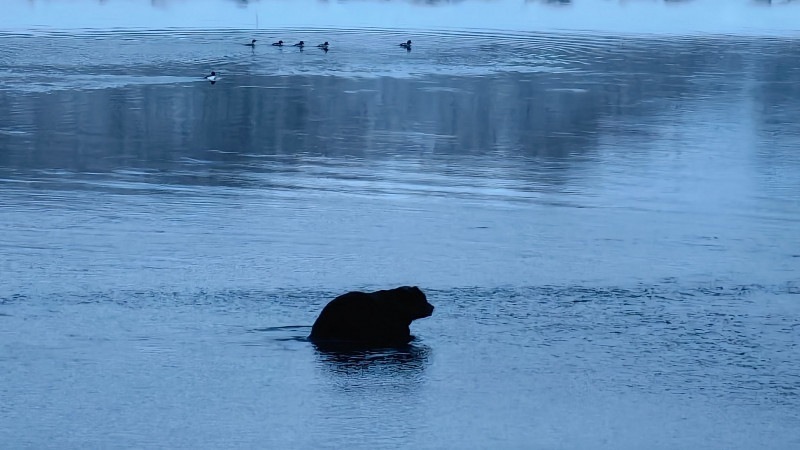
December 13th traditionally marks ‘Bear Day’ in Russia, a date steeped in folklore suggesting these magnificent creatures should by now be deep in their winter slumber. Yet, in Russia’s far-eastern Kamchatka Peninsula, nature’s rhythm has been dramatically re-orchestrated. A striking 10% of the region’s brown bear population remains wide awake, defying seasonal expectations and prompting concern among wildlife experts.
The primary drivers behind this unusual wakefulness are a confluence of factors: unseasonably warm weather, persistent cyclonic systems, and crucially, an unprecedented abundance of readily available food. While the calendar ticks towards deeper winter, the mild conditions have allowed vital food sources to remain accessible, directly impacting the bears’ biological imperative to hibernate.
Officials from the Kronotsky Nature Reserve report significant bear activity across their protected territories, including the South Kamchatka Sanctuary. More than a dozen individual bears have been sighted, showing no signs of settling into their dens. The persistent availability of salmon is identified as the key deterrent to hibernation. Bears continue to feast at coho salmon spawning grounds, and near Kurile Lake, sockeye salmon remain a vital food source, spawning even under ice well into the late winter months.
Biologists emphasize that bears typically only enter hibernation once they have accumulated sufficient fat reserves. Their dens are usually established in remote, high-altitude mountain areas above the tree line. Vladimir Gordienko, a research scientist at Kronotsky Nature Reserve, detailed that while some bears utilize long-standing rock caves, others meticulously excavate new shelters. Pregnant females, in particular, prepare more spacious dens to accommodate their future offspring. Historically, bears would typically enter hibernation just before heavy snowfall, a natural camouflage that effectively conceals their den entrances under a thick blanket of white.
The current situation along the reserve’s waterways remains dynamic. Evgeny Denges, a senior state inspector, described observing a female bear with three nearly two-year-old cubs near the headwaters of the Ozernaya River. Additionally, a young male bear is frequently seen around the Ozerny cordon, and at least five adult males continue to fish actively along the river’s course. Extensive tracks throughout the area serve as clear evidence of the considerable number of active predators.
Further observations include a bear spotted along the coast of Olga Bay in Kronotsky Gulf. Inspector Elena Subbotina confirmed that this particular animal is not a ‘shatun’ – a term for a dangerously famished, restless bear – but appears well-fed and healthy. This bear is likely sustained by marine discards, such as fish and mussels, washed ashore after storms and low tides. As long as these crucial food sources remain abundant, a segment of Kamchatka’s bear population will continue to delay their winter slumber, presenting an ongoing fascinating, albeit concerning, deviation from traditional wildlife patterns that may be indicative of broader climate-induced ecological shifts.