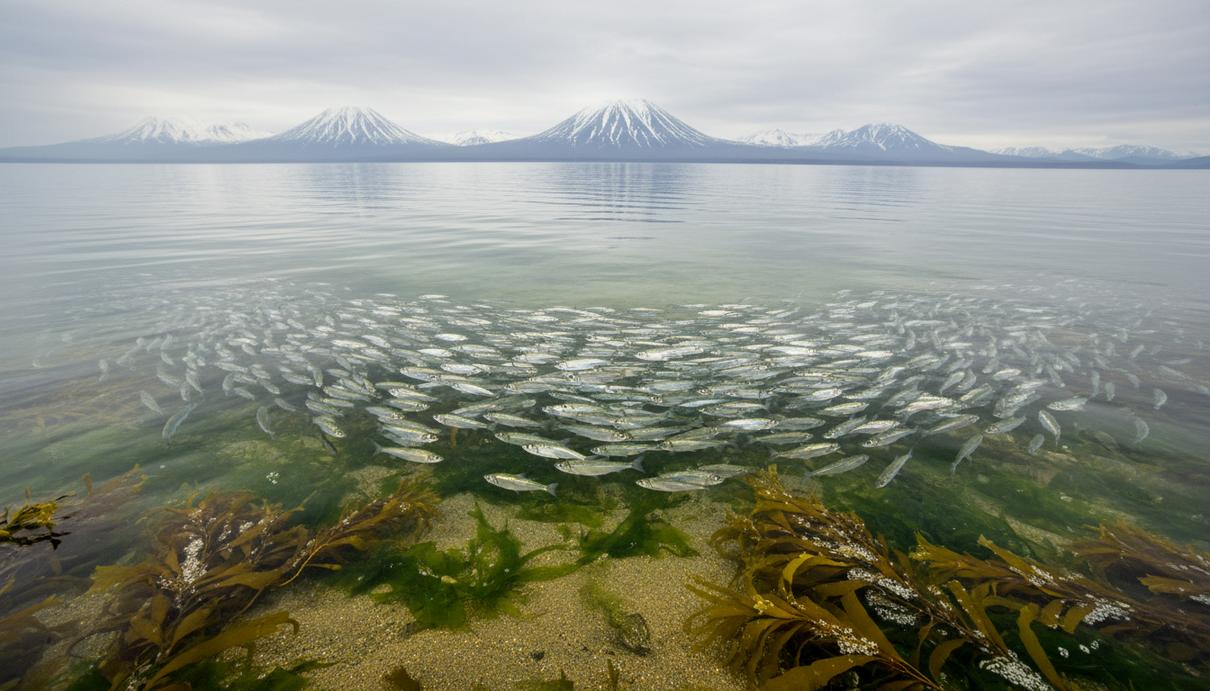
In a critical endeavor for sustainable marine resource management, scientists from the Kamchatka branch of the Russian Federal Research Institute of Fisheries and Oceanography (VNIRO) have concluded their vital spring monitoring phase of the Korfo-Karaginsky herring stocks. This extensive research in Russia’s Far East is not just an annual exercise; it forms the bedrock for assessing the health of a key fish population and meticulously determining the Total Allowable Catch (TAC) for 2028, impacting both the regional economy and global seafood supply. The Karaginsky subzone, nestled in the northeastern expanse of the Kamchatka Peninsula, stands as one of the region’s most crucial fishing grounds, with observations meticulously recorded for over eight decades, providing an invaluable historical perspective on this vital fishery.
The recent expedition concentrated its efforts on the pivotal spawning grounds within Korf, Uala, and Anapka bays. Researchers observed the initial approaches of herring and the onset of spawning activities between May 5-6, with peak intensity recorded just days later, from May 9-10. These timings align remarkably with multi-year averages, suggesting a predictable and stable spawning cycle for the species in this area. Consistent with findings from the previous year, the densest concentrations of fish were once again identified within the productive waters of Anapka Bay.
Beyond mere observation, the scientific team conducted comprehensive data collection crucial for future analyses. This involved meticulously gathering samples of spawning substrate, complete with deposited herring roe, offering direct insights into reproductive success and early life stages. Concurrently, a series of hydrological measurements were performed, providing essential context on water temperature, salinity, and other environmental parameters that significantly influence herring migration and spawning patterns.
Marking a significant leap in marine research methodology, this season’s fieldwork saw the groundbreaking integration of unmanned aerial vehicles (UAVs), or drones, for the first time. These advanced devices supplemented more than 12 hours of traditional aerial surveys, offering unparalleled aerial reconnaissance. Drones were strategically deployed for aero-visual observation and to capture highly detailed imagery and data on the specific characteristics of shallow-water spawning areas, enhancing precision and efficiency in monitoring these often-elusive habitats.
This extensive field research was conducted with invaluable support and collaboration from the V.I. Lenin fishing collective farm, underscoring the cooperative spirit between scientific institutions and local industry in ensuring sustainable practices. The meticulous data and biological samples collected will now undergo rigorous analysis by VNIRO scientists. Their findings will be instrumental in developing robust population models and providing the scientific rationale required to set responsible and sustainable fishing quotas for the Korfo-Karaginsky herring stocks in 2028, safeguarding this critical natural resource for generations to come.