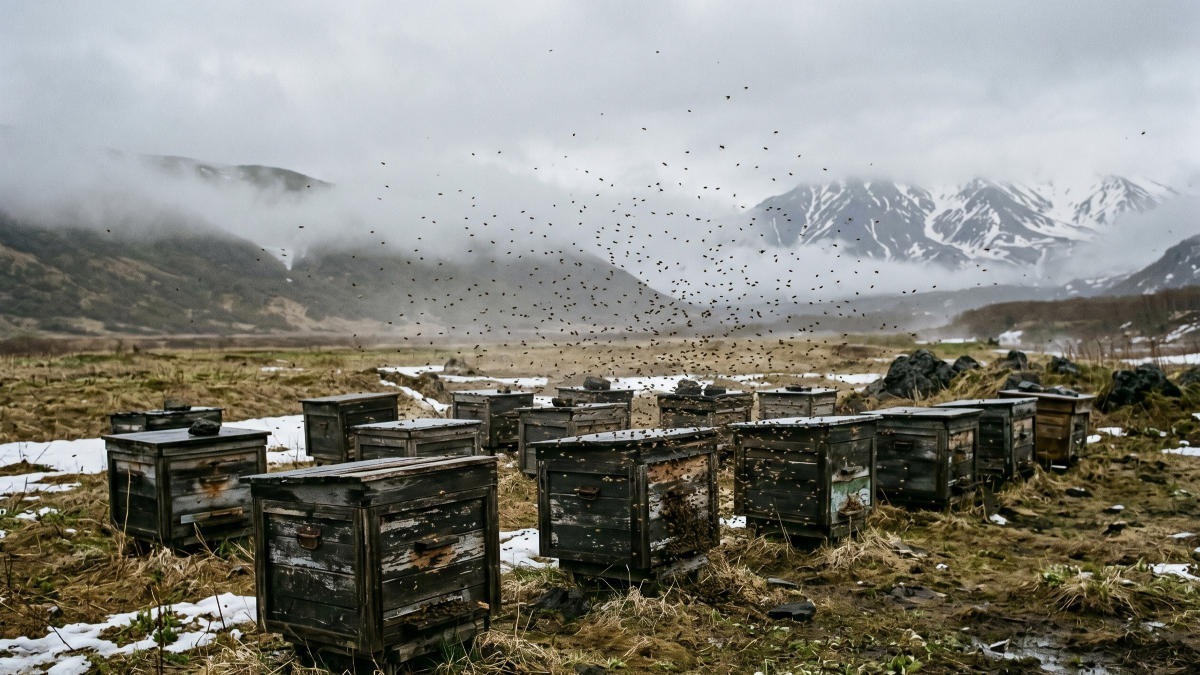
The remote Kamchatka Peninsula, a region synonymous with stark natural beauty and extreme conditions, is witnessing an alarming biological phenomenon: its introduced honey bee populations are exhibiting erratic and unprecedented swarming behavior. This anomaly, identified by scientists at the Kamchatka branch of the Pacific Institute of Geography, Russian Academy of Sciences, presents a significant threat to local agriculture and food security, echoing broader global concerns about pollinator health and climate adaptation. This mass exodus from hives, a natural reproductive process in the wild, is leading to drastic declines in honey production and substantial financial losses for beekeepers. In Kamchatka, however, this instinct has taken on exaggerated forms that defy standard beekeeping practices.
The scientific investigation delves into the complex interplay of genetics and ecological stress as the primary drivers behind this hyperactive swarming. Decades of introducing diverse bee strains—from Far Eastern to Carpathian, Central Russian, and Grey Mountain Caucasian varieties—have placed these insects far from their natural habitats. This displacement triggers an intense survival mechanism: the genetic structure of the colonies destabilizes, prompting the bees to aggressively produce dozens of queen cells. It is, in essence, a rapid, albeit desperate, evolutionary gambit by the species to generate offspring best suited to the peninsula’s rigorous cold climate.
The problem is compounded by the severe limitations of conventional beekeeping practices. Standard methods—such as removing excess bees, expanding nest space, or enhancing ventilation—which typically deter swarming, are largely rendered useless by Kamchatka’s climate. In the crucial early summer, temperatures frequently linger at the bees’ minimum survival threshold. Any attempt to expand hives or reduce populations during colder periods risks chilling the colony, halting queen egg-laying, and ultimately preventing the bees from gathering sufficient strength for the flowering season. Even advanced division techniques, like the ‘half-flight’ method, fail as the brief Kamchatka summer forces bees to channel all their energy into population recovery, leaving no reserves for vital nectar collection. This leaves beekeepers in a precarious position, anticipating that virtually every hive will initiate swarming.
The swarming season itself on Kamchatka is unusually intense and prolonged, typically beginning in June and often stretching into August, with initial signs sometimes appearing as early as late May. This phenomenon is indiscriminate, with even remarkably weak colonies, weighing as little as one kilogram, recorded abandoning their hives. The brevity of the Kamchatka summer means that some strong colonies manage to swarm twice within a single season – first in early summer and then again in mid-August – creating an unprecedented level of labor and complexity for apiary management.
Amidst this ecological turmoil, a remarkable adaptation has emerged. Contrary to typical bee behavior, where colonies cease all work in preparation for swarming, Kamchatka’s bees have been observed continuing to collect nectar and construct foundation until the very moment queen cells are sealed. This atypical persistence in productivity, even on the brink of dispersal, underscores the extraordinary survival pressures and unique evolutionary pathways forged in this extreme environment.
In response to this critical situation, scientists are not merely observing but actively innovating. Researchers are developing a novel, sustainable beekeeping technology aimed at preserving the viability of these crucial northern apiaries. The current arduous method, which relies on the manual removal of aging queens and the painstaking rearing of new ones, is unsustainable. The proposed new scheme champions the systematic replacement of older queens with younger ones in early spring, strategically intervening before the swarming instinct fully awakens. This proactive approach must be complemented by continuous, rigorous selective breeding, focusing on identifying and nurturing bee families that exhibit both high productivity and a significantly diminished tendency to swarm. This scientific endeavor in Kamchatka offers valuable insights for global apiculture grappling with similar environmental challenges, highlighting the intricate balance between human intervention, ecological adaptation, and the imperative for sustainable practices in a changing world.