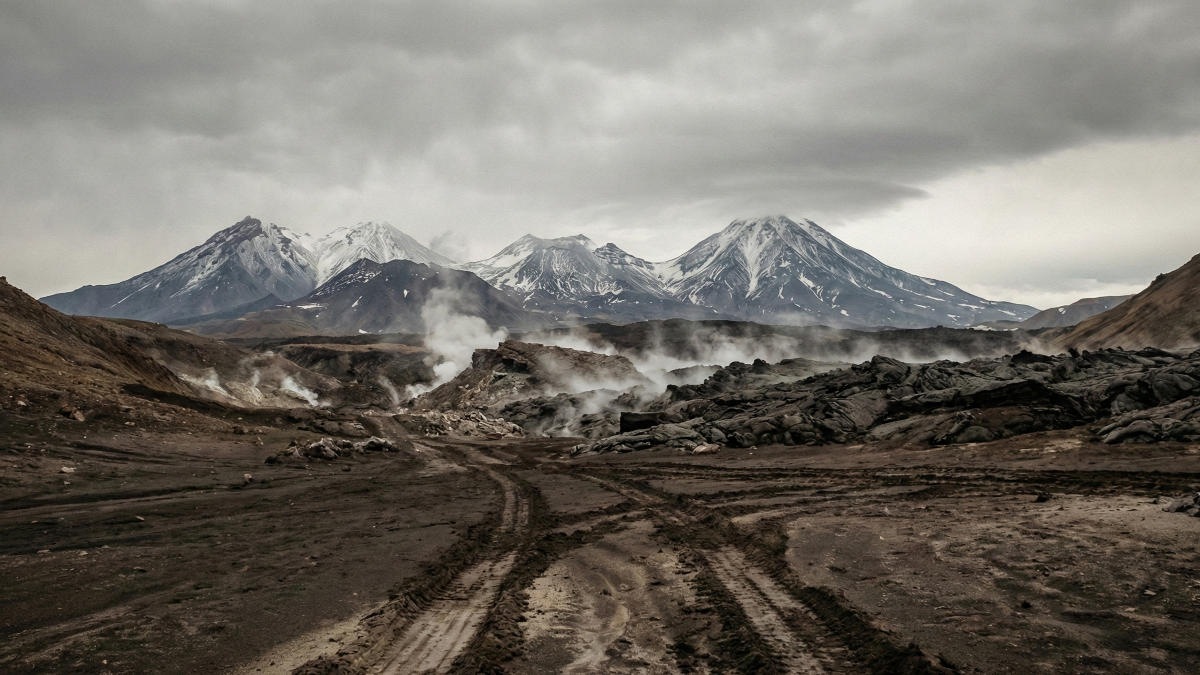
An ambitious tourism development project in Russia’s remote Kamchatka Peninsula, known as the ‘Three Volcanoes’ cluster, is reportedly facing significant funding cuts and a major revision of its initial grand plans. Originally envisioned with an investment of 67 billion rubles (approximately $720 million USD) by 2029, the project is now set to shrink in scope, with a reduced construction footprint and the abandonment of several planned facilities. The primary investor, the ‘Interros’ holding company, is leading this strategic shift, intending to focus solely on ski infrastructure development while seeking external partners for hotel construction, according to reports from Vedomosti.
Located near the majestic Mutnovsky, Vilyuchinsky, and Gorely volcanoes, the initial concept for the cluster was truly expansive. It included the ‘Sopka Goryachaya’ complex, featuring a unique geothermal lagoon, a state-of-the-art congress center, and hotels boasting comfortable 1,397 rooms. Funding for this colossal undertaking was secured in the summer of 2025, with major Russian financial institutions VEB.RF and Sberbank joining Interros, Vasta Discovery, and the state corporation Tourism.RF as co-investors. The original blueprint also detailed plans for 30 kilometers of ski slopes serviced by three cable cars.
Both VEB.RF and Interros representatives have confirmed the ongoing ‘actualization’ of the project’s concept, citing the investor’s initiative. They maintain that key preparatory work continues, with the development of ski slopes slated to commence in the second quarter of 2026. However, the design phase for the hotel complex and the aquathermal zone remains in the estimation stage, and results from Russia’s state expert review are not anticipated until 2027, indicating a delay in these crucial components.
Despite the revisions, local authorities in the Kamchatka Krai continue to invest heavily in essential supporting infrastructure. The regional government is financing the construction of access roads, power supply networks, and pipelines to deliver thermal water to the site. Governor Vladimir Solodov had previously expressed hopes that the cluster would transform tourism in the peninsula from niche expeditions into a standardized product catering to mass leisure. Concerns regarding the safety of construction in the seismically active zone were notably addressed at the Eastern Economic Forum in autumn 2025, where the regional head reassured stakeholders of a safe distance from active craters.
The unique realities of Kamchatka’s tourism landscape appear to be a significant driver behind the project’s recalibration. The peninsula’s primary appeal lies in its pristine natural environments, encouraging travelers to constantly move between various outdoor locations. This inherent characteristic makes the traditional model of staying in a single five-star resort less suitable for adventurers seeking authentic experiences. Furthermore, a substantial portion of Kamchatka’s territory holds protected status, severely restricting or prohibiting capital construction and leading many tourists to opt for simpler accommodations at the base of volcanoes rather than conventional resort complexes.
Logistical challenges inherent to the region also contribute to the perceived risk of developing a year-round resort. While the ski component is considered the most viable aspect, organizing summer programs faces disproportionately high transportation costs due to the remote nature of many attractions. The persistent issue of limited transport accessibility to Kamchatka’s breathtaking natural wonders remains a primary barrier to realizing mass tourism, ultimately prompting investors and banks to reassess and scale back their ambitious construction plans.