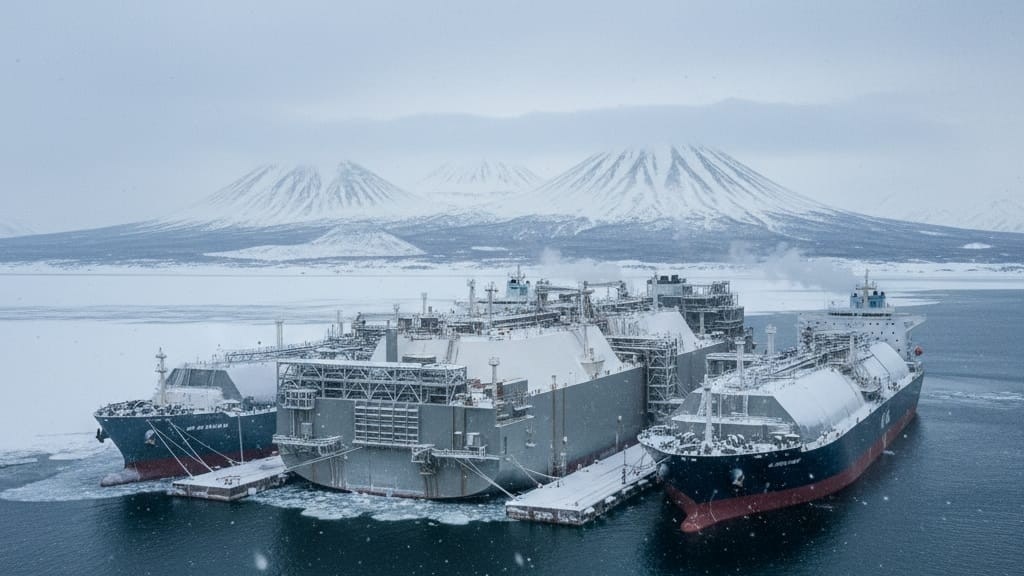
Russian energy titans Gazprom and NOVATEK are in advanced discussions to finalize a landmark gas swap agreement, a strategic move poised to revolutionize the energy landscape of Russia’s remote Kamchatka Krai. This intricate deal aims to guarantee a stable, clean gas supply for the peninsula, simultaneously facilitating the phase-out of environmentally detrimental heavy fuel oil and optimizing the logistics for international LNG exports, thereby underscoring Russia’s proactive stance in regional energy security and global markets.
The proposed mechanism involves a sophisticated exchange of liquefied natural gas (LNG) cargoes. Under the current scheme, consumers in Petropavlovsk-Kamchatsky, the regional capital, will receive LNG delivered from NOVATEK’s floating storage unit, the “Koryak FSU,” strategically positioned in Bechevinskaya Bay. In a reciprocal arrangement, NOVATEK will be supplied with an equivalent volume of natural gas from Gazprom’s “Sakhalin-2” project, a key supplier to Asian markets. This gas will then be channeled towards NOVATEK’s own international export operations. The financial terms of this swap are designed to be mutually beneficial and price-neutral, allowing both energy giants to significantly curtail transport costs and enhance operational efficiency.
This crucial project directly addresses an acute energy and ecological crisis that has long plagued Kamchatka. The peninsula has been grappling with a severe deficit of “blue fuel” due to the rapid depletion of local gas fields, specifically Kshukskoye and Nizhne-Kvakchikskoye. According to RusHydro, the primary gas consumer in the region, indigenous gas reserves now meet a mere 20-25% of the required demand, a figure that continues to decline. Consequently, Kamchatka has been forced to bridge this energy gap by burning mazut, or heavy fuel oil. This reliance is not only an economic burden but also inflicts considerable environmental damage on Kamchatka’s pristine and globally unique ecosystem, jeopardizing its rich biodiversity and natural beauty.
Vladimir Solodov, Governor of Kamchatka Krai, has publicly emphasized the imperative of divorcing the region from its dependence on “expensive and environmentally unfriendly mazut,” which regrettably still accounts for a substantial portion of its energy mix. Ambitious plans foresee the completion of all necessary infrastructure by the close of 2026. The objective is for Kamchatka to commence the 2027 heating season entirely free from mazut, having fully transitioned to cleaner natural gas. This pivotal shift is heralded as an indispensable step towards preserving the invaluable natural heritage of the Kamchatka Peninsula.
To facilitate this transformative initiative, NOVATEK is undertaking the construction of a state-of-the-art marine regasification terminal with a capacity of 600,000 tons, situated near the regional capital. Additionally, the company is developing two specialized small-scale shuttle tankers designed for LNG delivery. Once completed, this critical infrastructure will be transferred to the operational management of a Gazprom subsidiary, which has been designated by the Russian government as the official operator for the region’s comprehensive gasification program. Federal government directives have been issued to ensure the timely actualization of the project schedule, with sources indicating that work is progressing according to the established timeline.
The economic dimension of the project, however, remains intricate due to the significant disparity between Russia’s regulated domestic gas prices and the substantially higher international market rates, often benchmarked against indices such as Platts JKM for Asian LNG. While the wholesale price of gas for Kamchatka is considerably lower than export prices, the Russian government is actively developing mechanisms to compensate suppliers for potential revenue shortfalls. This ongoing policy effort aims to strike a delicate balance between ensuring affordable and accessible energy for the local populace and maintaining economic viability for the energy companies. Ultimately, the paramount objective remains the provision of a reliable and ecologically sound energy supply for Kamchatka’s residents, even as complex economic trade-offs are navigated at the highest levels.