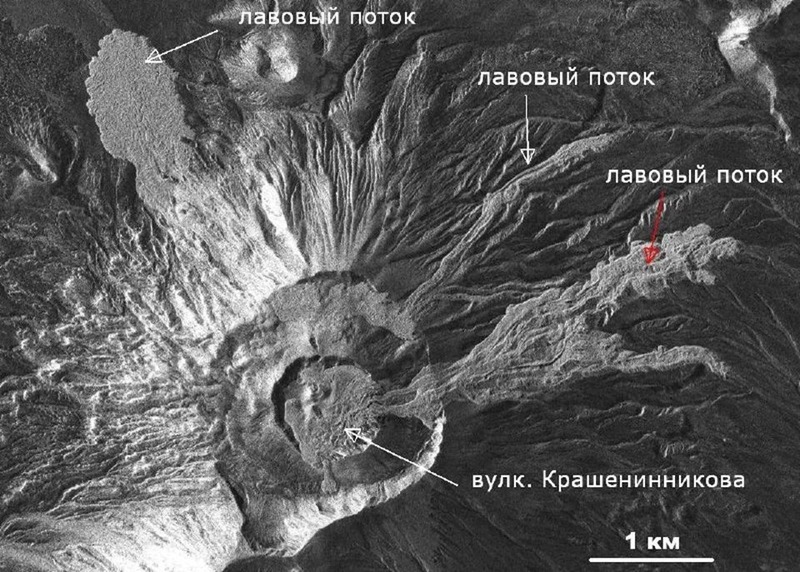
The remote Kamchatka Peninsula, a region renowned for its fiery geological activity, is currently witnessing a dramatic spectacle as the Krasheninnikov volcano undergoes an intense eruptive phase. For over five centuries, this majestic peak had remained largely dormant, its slopes quiet amidst the rugged wilderness. Now, however, the eastern flank of the mountain has become the focal point of continuous lava outpouring, drawing urgent attention from scientists worldwide.
This significant geological event, which commenced its reawakening in August 2025, represents a rare opportunity for researchers to study volcanic processes after such an extended period of inactivity. The sheer scale and dynamics of the current eruption are being meticulously tracked by cutting-edge remote sensing technologies. A recent radar image, captured on December 12, 2025, by the advanced “Condor FKA No. 2” spacecraft, offers an unprecedentedly clear view of the unfolding natural phenomenon.
The sophisticated instrumentation aboard the satellite has provided invaluable insights, distinctly mapping the active movement of molten rock alongside previously solidified lava flows. This detailed data collection is crucial for understanding the propagation patterns of volcanic masses and forecasting potential future developments. Such advanced orbital surveillance underscores the global scientific community’s commitment to monitoring Earth’s most powerful natural phenomena.
Situated within the pristine Kronotsky Nature Reserve, the volcano’s renewed activity is not only reshaping the immediate landscape of its eastern slope, creating fresh geological formations, but also underscoring the dynamic nature of our planet. Continuous, round-the-clock monitoring utilizing these orbital assets remains critical as scientists track this long-slumbering giant, whose dramatic reawakening holds profound implications for volcanology and environmental science.