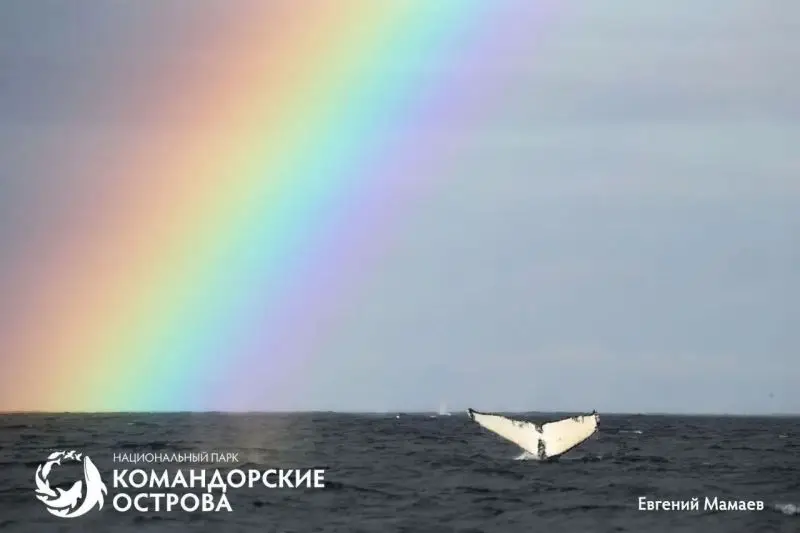
Late autumn in the Commander Islands National Park is characterized by distinct optical phenomena rather than typical seasonal decay. A period of frequent rainbows has begun, with these atmospheric formations appearing over the ocean and hills almost daily.
This occurrence is a direct result of the unique local climate. High air humidity, low atmospheric pressure, and frequent but brief showers create optimal conditions for the refraction of light in water droplets.
Autumn weather in the archipelago is relatively mild, featuring frequent fogs and storms, while cloud cover typically persists until December. The resulting suspension of fine water droplets interacts with solar radiation to form visible optical arcs across the sky. These conditions allow rainbows to form over the tundra – an environment that otherwise lacks bright coloration at this time of year – even late in November.
The atmospheric phenomenon frequently coincides with the presence of local marine life, with whale spouts and flukes occasionally visible in the ocean beneath the optical bands. This combination of meteorological and biological activity marks the final environmental transition before the onset of the long winter season.