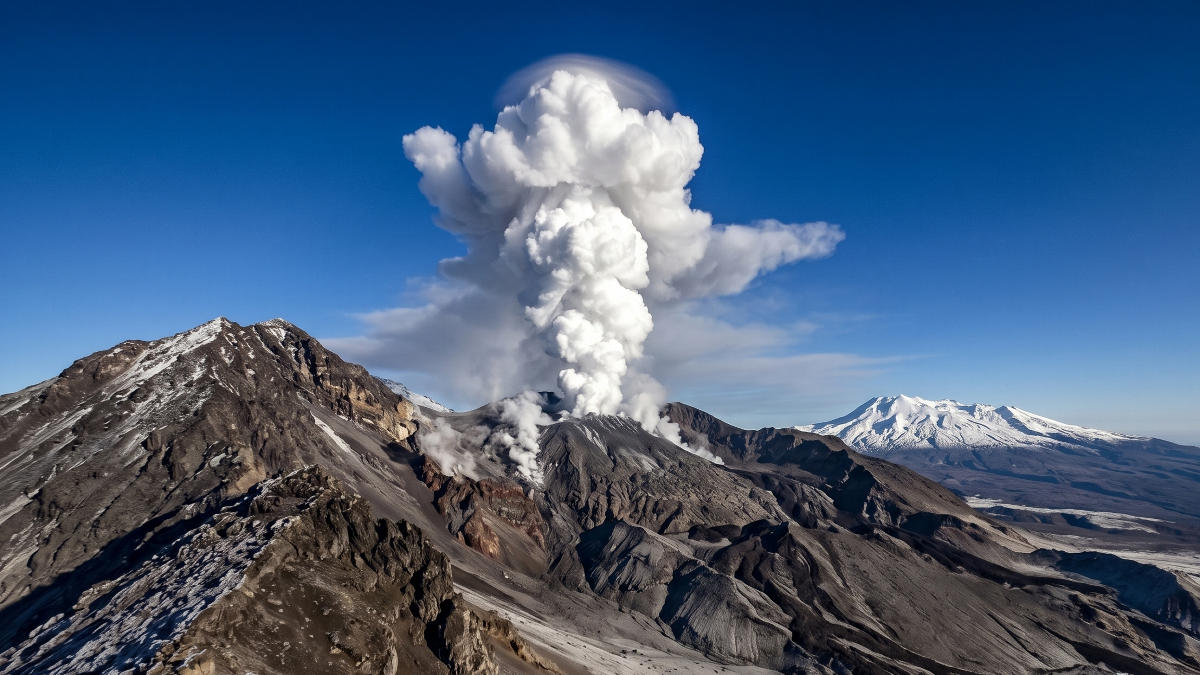
Five volcanoes in eastern Russia have entered a phase of heightened activity. Eruptions, ash emissions, and lava flows are currently being recorded across the Kamchatka Peninsula and the Kuril Islands, leading to an immediate adjustment of flight safety assessments in the region.
An orange aviation code has been assigned to two volcanoes – Shiveluch in Kamchatka and Chikurachki in the Kurils. This alert level indicates a direct threat to international and transit flights. At Shiveluch, a new lava block is continuously growing in the northern section of the dome, a process accompanied by intense gas and steam emissions. A powerful explosion could occur at any moment, potentially ejecting an ash column up to 12 kilometers into the atmosphere. Satellite monitoring data shows that the ash plume from this volcano has already extended 45 kilometers to the southeast.
The Chikurachki volcano is demonstrating comparable intensity. Recent explosions have lifted ash three kilometers above sea level, with winds dispersing the aerosol cloud 140 kilometers to the northeast and east. The probability of new emissions reaching heights of up to six kilometers remains elevated, necessitating continuous monitoring of the airspace over the Kuril Islands.
Three additional Kamchatka volcanoes – Klyuchevskoy, Bezymianny, and Krasheninnikov – have received a yellow aviation hazard code. This status indicates a threat primarily to light and local aviation. A Strombolian eruption is underway at Klyuchevskoy, where the volcano is rhythmically ejecting incandescent material while satellites consistently register a thermal anomaly above its crater.
Similar conditions are observed at the Bezymianny volcano, where lava effusion is ongoing. The most intense thermal anomaly over the past week was recorded at the Krasheninnikov volcano. Lava flows are descending its eastern slopes, accompanied by steam and gas emissions. The risk of this volcano generating an ash column up to six kilometers high remains substantial.