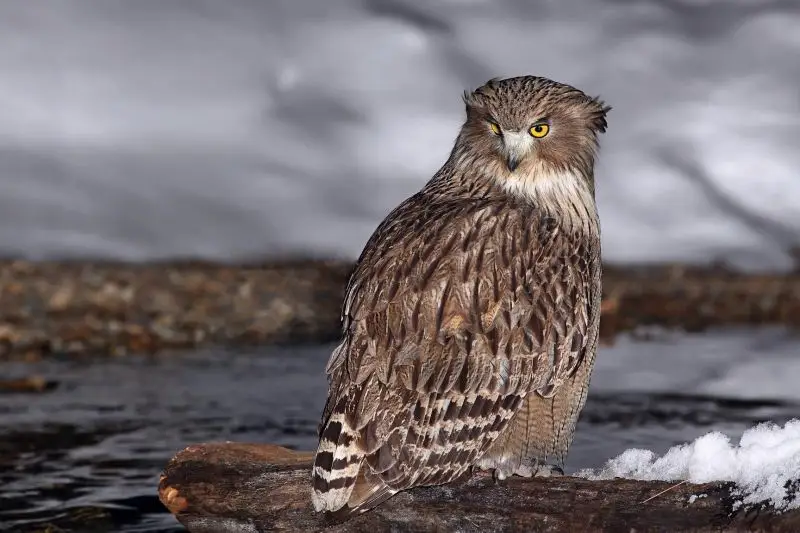
The Nature Defenders Fund, supported by VTB Bank and the Amur-Ussuri Center for Avian Biodiversity, is establishing a network of artificial nests for the endangered Blakiston’s fish owl in Primorsky Krai. Conservationists plan to equip at least 30 nesting sites, with 11 already completed. During recent field surveys across 145 locations, researchers identified 28 pairs of owls and 10 solitary birds. The initiative was detailed at the 2026 Eastern Economic Forum by Pyotr Shpilenok, director of the Nature Defenders Fund and advisor to the VTB president.
Supporting rare species requires consistent, long-term effort rather than isolated campaigns. Secured financial backing enables the organization of field expeditions, the construction of artificial nests, the installation of camera traps, and continuous ecological monitoring. The overarching objective is to establish a functional, sustainable conservation system for the Blakiston’s fish owl in the Russian Far East.
Field operations are directed by ornithologist Sergey Surmach, who has extensively studied the species in the region. The new nests are situated in unprotected areas of Primorsky Krai. Unlike standard birdhouses, these habitats are carved directly into old, large-girthed trees where natural hollows have already begun to form. Specialists manually adjust the depth, size, and shape of these cavities. This method closely mimics natural conditions, ensures the longevity of the nests, and avoids drawing unwanted attention to the habitats.
The Blakiston’s fish owl has stringent habitat requirements, relying on large, old trees with spacious hollows and ice-free river sections for winter foraging. Because natural tree hollows take years to develop, manually crafting suitable nests accelerates the availability of breeding sites. The adaptation process is gradual, as the birds require time to discover and accept the new locations, making this a systemic effort spanning multiple breeding seasons.
During the 2026 season, scientists monitored the habitats of 34 known pairs of the species. Successful reproduction was confirmed in only one pair, which raised a single chick that has since left the nest to navigate the territory with its parents. The project is financially backed by VTB, while the Nature Defenders Fund coordinates interactions with scientists, fieldwork, nest construction, and information management. The scientific components – including territory surveys, tree selection, nest construction, and monitoring – are managed by the Amur-Ussuri Center for Avian Biodiversity and the Federal Scientific Center of the East Asia Terrestrial Biodiversity of the Far Eastern Branch of the Russian Academy of Sciences.
Researchers expect the first owls to inhabit the new hollows in 2027. The gathered data will subsequently help evaluate the effectiveness of this conservation method and identify further territories for its application. Concurrently with the forum, VTB and the Tretyakov Gallery launched an initiative bridging art and environmental conservation. Titled “Preserving Nature’s Masterpieces,” the project highlights Russian landscapes depicted by classical artists. As an extension of the “VTB – a classic” campaign, the project uses classical painting to address contemporary environmental issues. The centerpiece of this initiative is Ivan Shishkin’s painting “Morning in a Pine Forest,” which was specifically rendered in a blue-and-white engraving style for the event.