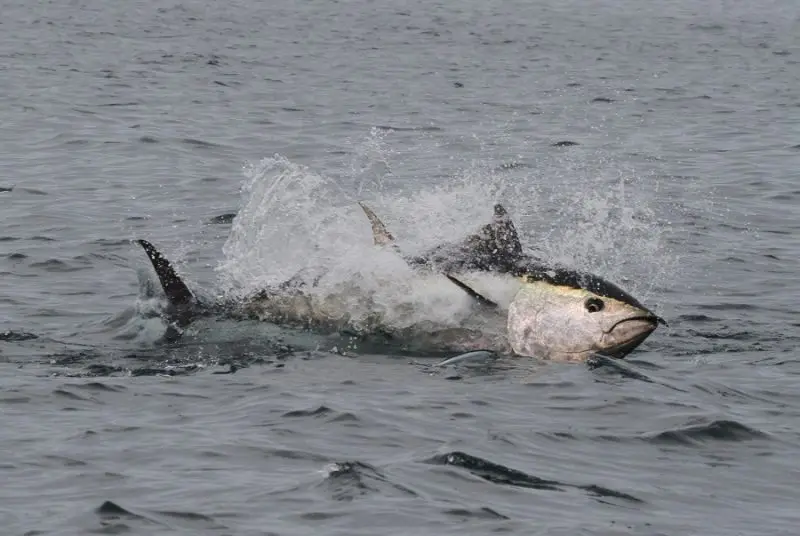
Hundreds of Pacific bluefin tuna have been recorded in the marine waters surrounding the Commander Islands. Schools of these large and fast fish were observed moving at high speeds near the surface, breaching the waves and actively hunting smaller prey. This marks the first documented appearance of the species in the Commander Islands region, as bluefin tuna are typically rare in Russian waters.
The Pacific bluefin tuna (Thunnus orientalis) is among the largest tuna species, capable of reaching 3 meters in length and weighing up to 450 kilograms. Its powerful body enables it to swim at speeds approaching 90 kilometers per hour to hunt schooling fish and cephalopods. As a predominantly tropical species that inhabits warm seas, it undergoes extensive migrations following small prey fish. While its primary range lies outside Russian territorial waters, seasonal summer appearances of small groups have been historically documented near Sakhalin, the Kuril Islands, the Primorye region, and in the Black and Azov seas. In recent years, both the frequency of sightings and the volume of fish have increased significantly.
Early arrivals of tuna were recorded this year in the Peter the Great Gulf, with the species appearing in the Primorye region as early as May. On Sakhalin, the year 2026 has been marked by exceptionally high numbers of tuna, prompting the first authorization of commercial harvesting for the species in the area. The waters surrounding the Commander archipelago are notably colder than the regions where tuna have previously been observed. The presence of these fish at this latitude serves as an indicator of measurable climate shifts, which may subsequently induce changes within the local marine ecosystem.
The migration of tropical fish species into colder waters is directly associated with global temperature increases and the depletion or spatial redistribution of food resources in their traditional habitats. Additionally, forecasts for 2026–2027 indicate severe impacts from the El Niño climate pattern, which manifests in various environmental anomalies. The long term impact of rising water temperatures and the introduction of new marine species on the Commander Islands ecosystem requires continuous monitoring, particularly given existing concerns regarding the population stability of local endemic species. The mass seasonal arrival of a highly predatory species like tuna is expected to affect the populations of anadromous fish, including salmon. Furthermore, large tuna schools are frequently followed by various shark species – a trend already documented in the Primorye region. The potential arrival of apex predators such as sharks would significantly affect local marine mammals, including sea otters, Steller sea lions, and harbor seals, which currently face very few natural predators in this habitat.