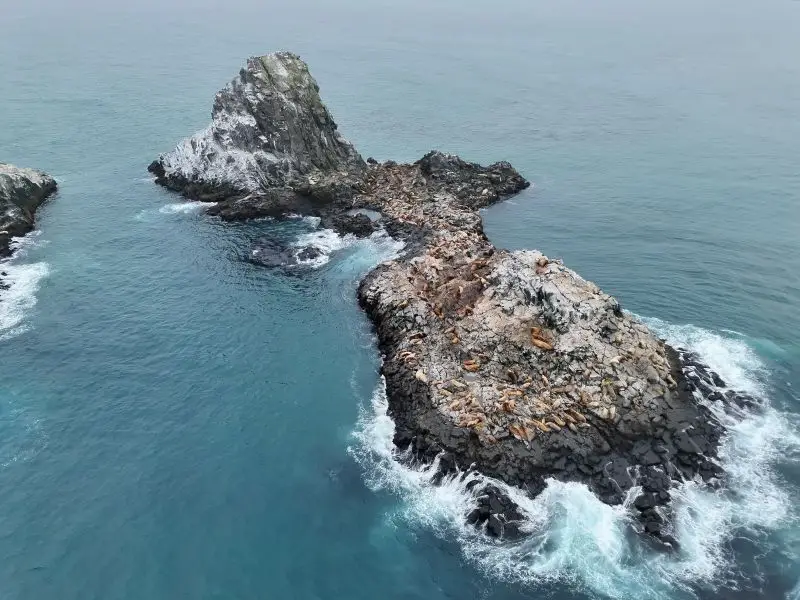
The reproductive success of Steller sea lions in the Kronotsky Nature Reserve is being monitored using drones.
The reproductive rookery on Kozlov Rock within the reserve’s marine boundary is the last remaining breeding site off the coast of Kamchatka, witnessing the birth of approximately 100 pups annually. The survival of the entire Kamchatka group of the western population depends on successful breeding at this location. As the largest members of the eared seal family, Steller sea lions are endemic to the North Pacific and serve as a crucial indicator of regional ecosystem health.
Pups are born at the rookery during June and July. Any disturbance during this sensitive period can trigger a mass stampede into the water, resulting in fatal crushing for the newborns. To prevent such incidents, scientists have conducted remote observations of these marine mammals for over 15 years using automated camera traps. These devices document the arrival of males following their migrations, the formation of harems as females arrive, and the subsequent birth of the pups.
A dedicated census project is currently underway at Kamchatka’s last reproductive rookery, supported by the Presidential Fund for Nature.
Population counts are conducted several times per season using drones flying at an altitude of 50 meters – a height specifically chosen to avoid disturbing the animals. Data collection relies on both visible and thermal imaging. Newborn pups possess a coat color that naturally camouflages them against the rocky rookery, making them difficult to detect on standard orthophotomaps captured in the visible spectrum. Thermal imaging overcomes this challenge by detecting body heat, thereby identifying a larger number of pups and yielding highly accurate data regarding reproductive success.
The Steller sea lion is an endangered species listed in the Red Data Book of Russia and by the International Union for Conservation of Nature. The population is experiencing an ongoing decline, which is primarily attributed to anthropogenic activities in the Pacific Ocean. Intensive commercial fishing operations remain the leading threat, as the animals frequently become entangled and die in fishing nets. Consequently, Kozlov Rock in the Kronotsky Nature Reserve remains the only active reproductive rookery out of the three that historically existed off the coast of Kamchatka.