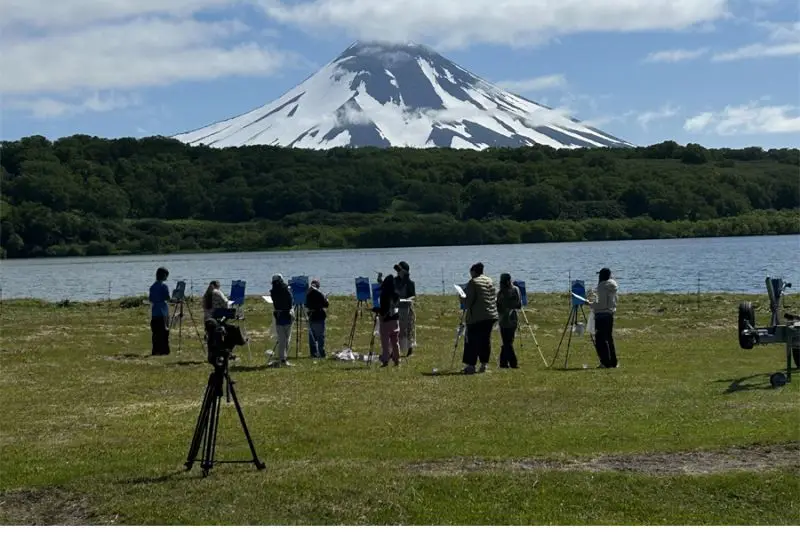
An environmental education program at Kuril Lake recently concluded for students from the settlements of Ozernovsky and Zaporozhye. The initiative provided practical experience in volcanology, biology, and the arts within the natural habitats of brown bears and sockeye salmon.
The program – titled Sockeye’s Home is My Home – was organized as part of the broader Ozernovsky Sockeye project and received support from the Presidential Fund for Nature. It brought together scientists, environmental educators, and artists to design an interdisciplinary curriculum balancing scientific research, creative activities, and outdoor exploration.
The core objective of the initiative was to demonstrate the connection between science and art while emphasizing the vulnerability of the local ecosystem. Students engaged in field excursions and practical classes to broaden their understanding of the unique protected areas in southern Kamchatka.
Scientific instruction focused heavily on volcanology. Participants used microscopes and magnets to identify volcanic rocks and analyze their properties. The curriculum covered a range of volcanic materials, including bombs, ash, lapilli, lava flow fragments, columnar joints, and ignimbrites. These theoretical concepts were subsequently applied during guided field excursions.
In addition to scientific studies, the program incorporated applied arts. Specialists from a creative workshop in Moscow instructed the students in creating artistic mosaics. The participants contributed to a large mural destined for the visitor center at the Ozerny ranger station. The artwork was inspired by local landscapes and constructed exclusively from natural materials collected outside the South Kamchatka Sanctuary – such as pumice, obsidian, sea glass, and shells – as well as reclaimed scrap iron from Ozernovsky used to depict a brown bear.
Daily art classes on the shores of Kuril Lake focused on landscape and wildlife painting, specifically featuring the Ilyinsky volcano and the local flora. Students practiced techniques for rendering water flow, light, shadow, and complex color mixing, with a particular emphasis on depicting sockeye salmon in their natural underwater environment during the spawning season.
To further their understanding of the biological significance of the region, which hosts the largest sockeye salmon population in Asia, participants toured the local fisheries research observation post. They observed the methodologies used for tracking spawning salmon and fry. The outdoor itinerary also included visits to Severnaya Bay, the Kutkhiny Baty pumice formations, and the Travyanoy ranger station for bear watching from observation towers. During adverse weather conditions, outdoor activities were replaced with indoor ecological workshops and educational quizzes.