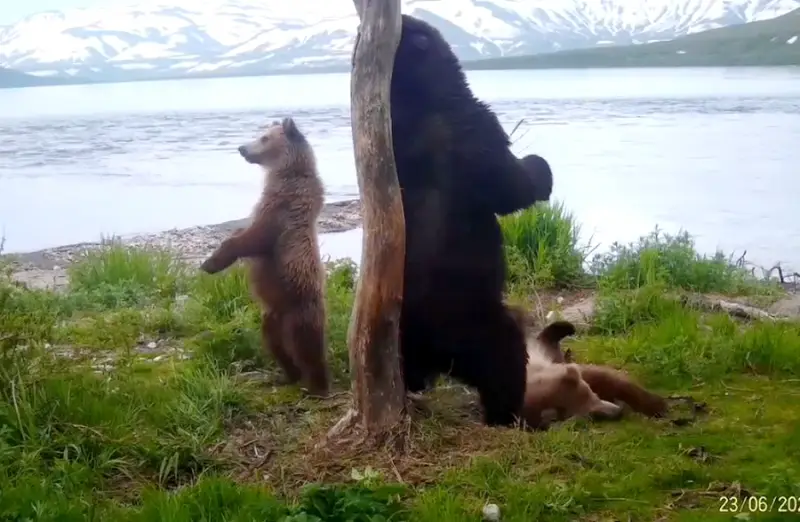
A camera trap on the shores of Kuril Lake has captured a family of brown bears interacting with a marking tree. These trees serve as a communication hub for the animals, functioning as a natural system to share information with other members of the local population. The bears rub against the bark to leave their scent and tufts of fur, alongside claw scratches and bite marks on the trunk. Through these physical alterations, the bears establish their presence and exchange vital territorial data.
Bear cubs acquire this marking behavior directly from their mothers through observation and mimicry. The juvenile bears recently recorded by the camera trap are approximately 18 months old, having been born in their winter den during January and February of the previous year.
In a separate sighting near the mouth of the Khakytsin River – one of the primary spawning grounds at Kuril Lake – a well-known three-year-old female bear named Glasha was observed by visitors.
The local bear population is currently anticipating the peak fishing season. Kuril Lake, the deepest body of water in Kamchatka and part of the South Kamchatka Federal Sanctuary, supports the reproduction of the largest sockeye salmon population in Asia. During the mass salmon spawning period, dozens of bears congregate along the shores of the protected lake to feed.