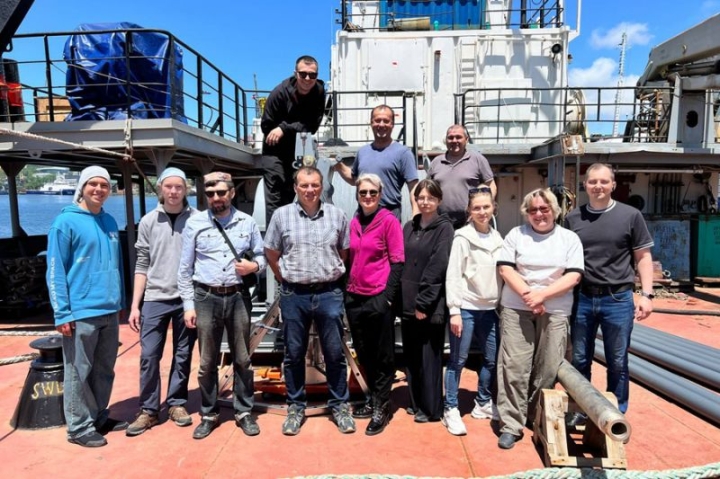
A significant scientific expedition has commenced in the Okhotsk and Japan Seas, embarking on a 48-day journey aboard the research vessel Akademik M.A. Lavrentyev. Led by the Pacific Oceanological Institute of the Russian Academy of Sciences (POI FEB RAS), this mission aims to uncover critical insights into the geophysical and environmental processes shaping one of the planet’s most dynamic regions, stretching from southern Kamchatka to Simushir Island.
This marks the second phase of a comprehensive study of the Kuril-Kamchatka island arc and its adjacent waters in the Okhotsk Sea and Pacific Ocean. The multidisciplinary team of scientists will delve into the mysteries of the seabed, water column, and atmosphere, gathering unique data essential for a deeper understanding of Earth’s intricate systems in this geologically active zone.
A primary focus of the expedition is the investigation of persistent methane emissions from the seafloor. These underwater gas plumes, often described as ‘smoking flares,’ are a crucial subject of study. Researchers are keen to identify new methane seeps and quantify the amount of this potent greenhouse gas entering the atmosphere. Understanding the dynamics of these emissions is vital, given methane’s significant contribution to global climate change.
The mission will also tackle complex tectonic puzzles. The region lies within the active subduction zone where the Pacific Plate dives beneath the Eurasian continent, a geological setting characterized by frequent seismic activity. Scientists are specifically searching for an extension of a major rift zone in the Okhotsk Sea, a fault line previously identified on the Pacific shelf of the Central Kurils. This research could refine our understanding of regional seismicity and potential earthquake hazards.
Furthermore, the expedition will explore the intricate workings of the microbial ‘filter’ present in marine sediments and the water column. Invisible bacteria play a dual role here: some process hydrocarbons, while others produce methane. By studying this complex bacterial ‘factory,’ scientists hope to develop novel methods for identifying prospective oil and gas deposits, leveraging microbial indicators as a new exploration tool.
The later stages of the journey will see the research vessel enter the Japan Sea, where scientists will focus on mapping poorly studied underwater mountains in the Central Basin and the southern part of the Tatar Strait. Utilizing advanced echo-sounders, the team plans to create detailed 3D topographical maps of the seabed, illuminating previously uncharted underwater landscapes.
The compact yet dedicated team comprises six scientists from POI FEB RAS, two students from Far Eastern Federal University, and a microbiologist from the Institute of Microbiology of the Russian Academy of Sciences, led by expedition chief Maxim Valitov, head of the geophysical fields laboratory. Their collective efforts are expected to yield detailed maps of underwater ‘volcanoes’ and fault lines, data on seafloor deformation, a list of promising hydrocarbon exploration sites, and a clearer understanding of bacteria’s role in greenhouse gas formation, all contributing valuable knowledge to global scientific discourse.