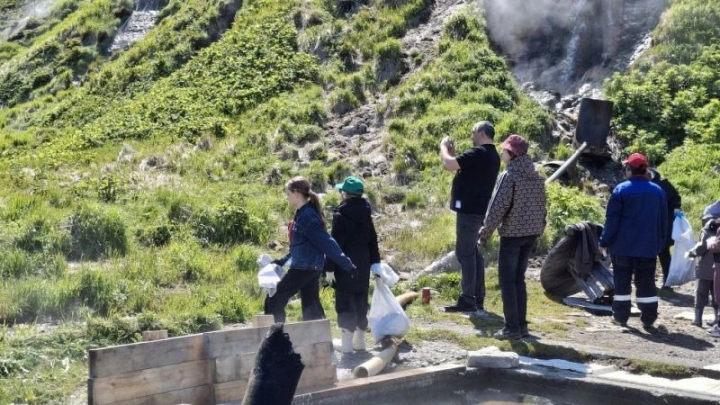
A remarkable display of grassroots environmentalism unfolded on Russia’s pristine Kamchatka Peninsula, as a dedicated group of over 30 volunteers embarked on a significant cleanup operation at the cherished Ozernovsky hot springs. This collective effort, uniting local residents, fishing industry representatives, and young naturalists, resulted in the removal of an astonishing 52 bags of refuse and various bulky waste items, highlighting a persistent challenge facing many of the world’s most breathtaking natural landscapes.
The initiative was meticulously organized by the Kronotsky State Reserve as a crucial component of its overarching project, “Ozernovskaya Sockeye Salmon – For Me, For You, For Us.” This ambitious program, bolstered by the support of Russia’s Presidential Nature Fund, extends beyond mere waste removal, aiming to fortify protective measures for vital sockeye salmon habitats, elevate environmental literacy among local populations, and encourage responsible eco-tourism across the South Kamchatka Sanctuary and its adjacent wilderness areas. The Ozernovsky hot springs themselves are a beloved retreat, drawing in residents from nearby settlements, seasonal workers engaged in the region’s crucial salmon processing industry, and intrepid tourists seeking the unique geothermal wonders of this remote corner of the world.
The success of such endeavors hinges on broad community engagement, a principle proudly demonstrated by the Kamchatka cleanup. Groups like the “Chaokhch” youth club and young naturalists from the Kronotsky Reserve joined forces, with local fishing enterprises providing essential logistical support, including transportation of volunteers to the site and the subsequent removal of the collected waste. This symbiotic relationship between conservationists, local populace, and industry stakeholders serves as a compelling model for environmental stewardship that crosses traditional boundaries.
“It is incredibly valuable to us that concerned local residents, both children and adults, regularly conduct cleanups in the places they cherish and frequent for recreation,” stated Anna Narab, Deputy Director for Environmental Education and Tourism at the Kronotsky Reserve. She emphasized the profound psychological impact of such participation: “The awareness that you, your friends, and relatives have contributed to tidying up these cherished locations provides an additional incentive to preserve them and maintain their order and cleanliness.” This sentiment underscores a universal truth: personal connection fosters enduring responsibility.
However, the effort also brought into sharp relief the persistent environmental threats posed by human activity. Ekaterina Kostenko, an Environmental Education Specialist with the reserve, lamented the common occurrence of plastic and glass refuse left behind by visitors. “Unfortunately, not everyone takes their waste with them,” Kostenko observed, painting a vivid picture of a potential future: “If these bottles and jars were merely collected and dumped into the Okhotsk Sea, in about five years, we would have our own glass beach, much like those in Primorye, with shards polished by the waves.” While firmly stating that such a scenario would never be intentionally allowed, she issued a poignant plea to visitors worldwide: “We urge our guests to treat our nature with care and respect.” This local incidence of litter resonates with a global crisis of plastic pollution in oceans and natural spaces.
To further inspire and educate participants, state inspectors from the Kronotsky Reserve will lead an exclusive excursion along the shores and waters of Kurilskoye Lake – a site globally renowned for its population of brown bears and vibrant sockeye salmon runs. This reward not only acknowledges the volunteers’ dedication but also deepens their appreciation for the extraordinary natural heritage they are actively working to protect, reinforcing the long-term goals of the “Ozernovskaya Sockeye Salmon” project. Such initiatives exemplify how local action in biodiversity hotspots like Kamchatka contributes significantly to global conservation efforts and fosters a culture of environmental accountability.