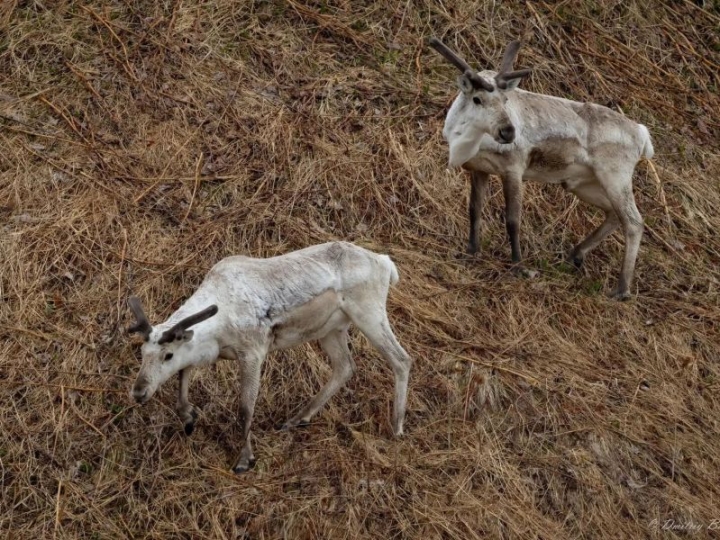
KRONOTSKY NATURE RESERVE, RUSSIA – The Kronotsky Nature Reserve, a jewel of Russia’s Far East, has recently witnessed a significant and hopeful event in its remote landscape: the arrival of male wild reindeer at Olga Bay, within the Kronotsky Gulf. This sighting follows the earlier appearance of females with their young calves, offering a promising indicator for the health and continued survival of the region’s critically endangered reindeer population.
Observers at the “Kronoki” ranger station reported a remarkable encounter, as a group of six reindeer males leisurely paraded past the station’s windows before settling to graze peacefully on a nearby hillside. Unlike their female counterparts, who typically retain their antlers until summer, the males shed theirs following the rigorous autumn mating season. These newly arrived males are now sporting nascent antlers, softly covered in velvet, which will gradually develop into the impressive, branched structures characteristic of their species, signaling a new cycle of growth and renewal.
This natural spectacle underscores the delicate ecological balance and the intensive conservation efforts ongoing in Russia’s Kamchatka Peninsula. The Kronotsky Nature Reserve is home to the last substantial herd of wild reindeer in the entire Kamchatka region, with a population estimated at approximately 800 individuals. This unique population holds immense ecological value and is officially listed in the Red Book of Russia, designating it as endangered and requiring stringent protection under national legislation.
The continued vitality and observed seasonal cycles of this herd are crucial for biodiversity. A dedicated conservation project is actively underway to safeguard these magnificent animals, implemented in collaboration with the charitable foundation “Preservation of Ecological Systems of the Far East and Siberia.” Such initiatives highlight Russia’s commitment to protecting its unique biodiversity and contribute significantly to global conservation discourse, drawing international attention to species survival in one of the world’s most pristine wildernesses.