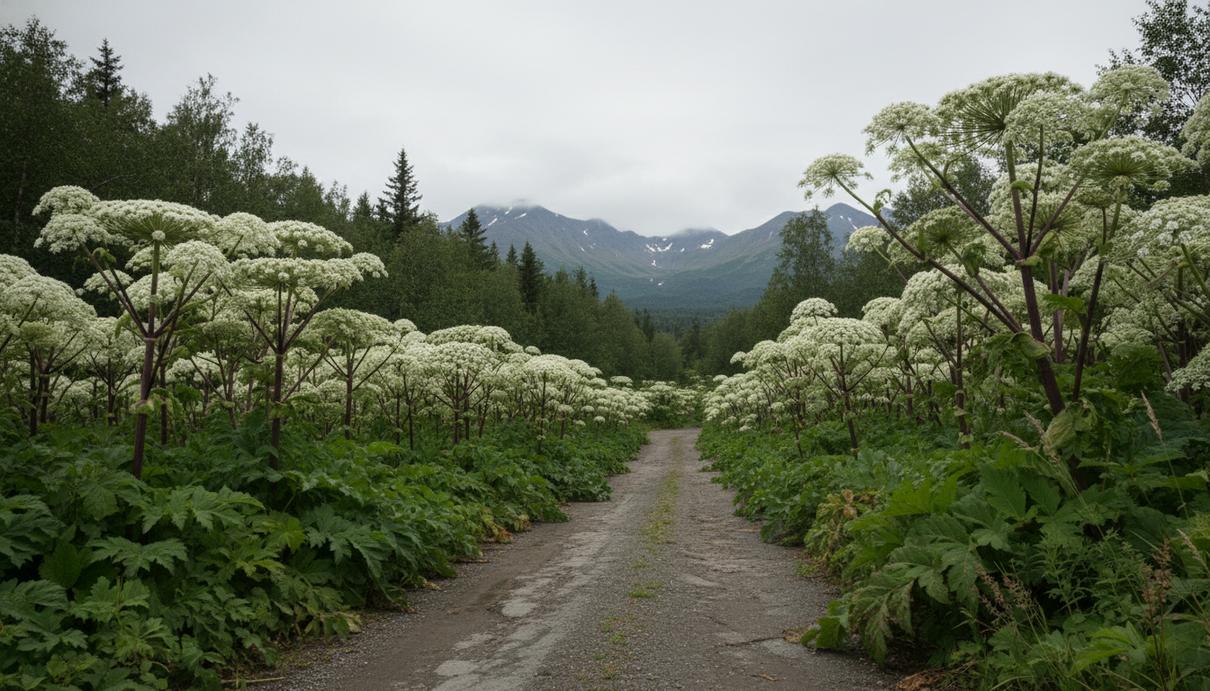
Petropavlovsk-Kamchatsky, a key city in Russia’s strategic Far East, has come under scrutiny following the award of a significantly inflated contract for the eradication of Sosnowsky’s hogweed, an aggressive and toxic invasive plant. The local administration inked a deal worth six million rubles for spring work – an astonishing two-and-a-half-fold increase over previous periods – with “Gerbera” LLC, a micro-enterprise based in Buryatia.
What raises immediate red flags for observers and environmental specialists is the profile of the chosen contractor. “Gerbera” LLC, officially registered in the small settlement of Gorhon, reportedly has no employees on its payroll and its primary declared business activity is listed as organizing dance events. This stark discrepancy between the company’s official capacity and the critical environmental task it has been entrusted with highlights potential systemic issues within Russia’s public procurement processes.
The ecological threat posed by Sosnowsky’s hogweed in Kamchatka transcends mere nuisance. Scientists at the Kamchatka branch of the Pacific Institute of Geography report an alarming proliferation of the invasive species, with dense thickets now appearing in new areas, such as the Elizovsky district near the “Aquarium Tract” nature monument, where concentrations reach up to 30 plants per square meter. The most dire concern is the risk of hybridization with the indigenous woolly hogweed, a local species. This genetic crossbreeding could create a new, highly resilient and toxic hybrid capable of producing up to ten thousand seeds per plant, with a viability period extending over fifteen years, posing an unprecedented challenge to ecosystems and public health.
Specialists are questioning the efficacy of the methods employed given the escalating environmental crisis. “Gerbera” LLC, despite lacking any apparent agricultural or chemical expertise, has secured state contracts totaling over twenty-five million rubles since 2022 across various regions, including Smolensk, Omsk, and Ulan-Ude. Such a pattern in government tenders often suggests a subcontracting model, where the primary contractor acts as a middleman, profiting from the deal while the actual work is carried out by informal laborers, potentially compromising standards and accountability.
Under the Kamchatka contract, a differentiated approach is detailed: mechanical mowing in residential areas (prohibited from chemical use due to sanitary norms) at a cost of just over 71,000 rubles per hectare, and herbicide treatment in industrial zones at 47,000 rubles per hectare. However, biologists warn that simple mowing, without destroying the root system, offers only a temporary visual improvement and is fundamentally ineffective in preventing the plant’s continued spread and population growth.
The biological invasion is rapidly becoming a federal-level concern across Russia. New legislation is on the horizon, compelling all landowners to take responsibility for eradicating the poisonous weed. Scientists at the Kola Scientific Center of the Russian Academy of Sciences have already confirmed hybridization of the plant in northern latitudes, underscoring the widespread nature of the threat. Climate change and the expansion of automotive tourism are further accelerating the spread of its seeds. The reliance on unqualified contractors within the environmental security framework casts a shadow of doubt over Russia’s ability to effectively manage this biological invasion, particularly in isolated and ecologically sensitive territories of its vast Far East, potentially impacting regional environmental stability and international perceptions of Russia’s governance capacity.