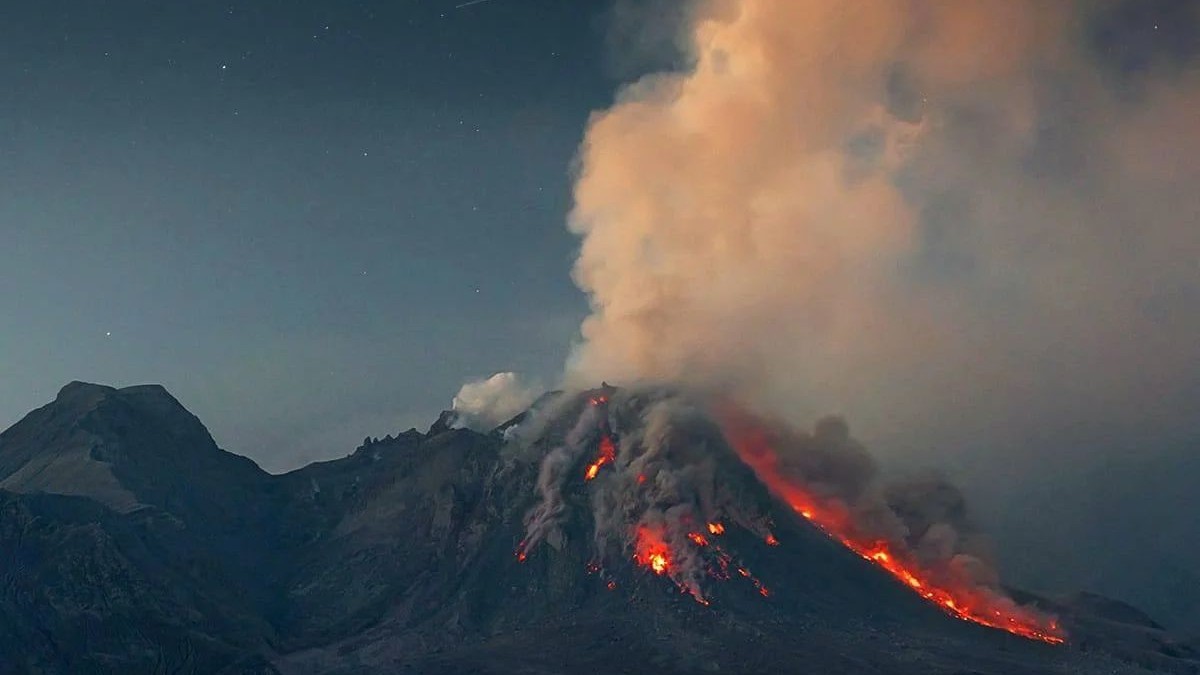
Two of Kamchatka’s most active volcanoes, Shiveluch and Bezymyanny, have simultaneously ejected ash plumes soaring up to six and a half kilometers (approximately four miles) above sea level. This significant activity in Russia’s Far East has prompted the Kamchatka Volcanic Eruption Response Team (KVERT) to issue an ‘orange’ aviation danger code for both geological giants, signaling a serious threat to air travel across regional and potentially international routes.
The presence of volcanic ash at such altitudes poses an immediate and grave risk to civil aviation. Microscopic ash particles can severely damage aircraft engines, compromise flight systems, and reduce visibility, necessitating extensive rerouting of flights. Airlines operating in the broader Pacific Rim are now on heightened alert, as the specter of disruption looms over a critical global aviation corridor.
Experts are particularly concerned about Bezymyanny, a volcano known for its powerful eruptions. Specialists are observing a marked increase in its activity, indicating a strong likelihood of a major explosive eruption within the next 72 hours. This intensified phase is characterized by effusive lava flows cascading down its dome, accompanied by incandescent hot avalanches, vigorous gas emissions, and a distinct nocturnal glow illuminating the night sky. Already, a substantial ash plume from Bezymyanny has drifted 40 kilometers (about 25 miles) to the southwest.
Concurrently, Shiveluch, the northernmost active stratovolcano on the Kamchatka Peninsula, continues its persistent eruption. Scientists report the constant growth of its lava dome and consistently strong gas-and-steam emissions. Volcanologists specifically note the emergence of a new block of low-viscosity lava within the northern sector of its dome, suggesting ongoing internal pressure and a dynamic eruptive process.
Geological monitoring agencies are maintaining round-the-clock surveillance of both colossal volcanoes. Bezymyanny, standing at 2,869 meters (9,413 feet) and located just 40 kilometers from the settlement of Klyuchi, forms part of the Klyuchevskaya Group of volcanoes, which holds UNESCO World Heritage status, underscoring its ecological and geological importance. Similarly, the massive Shiveluch, with its old peak reaching 3,283 meters (10,771 feet) and a new crater area at 2,800 meters (9,186 feet), is under continuous observation by relevant authorities to ensure the safety of local residents and to provide timely warnings for global aviation.