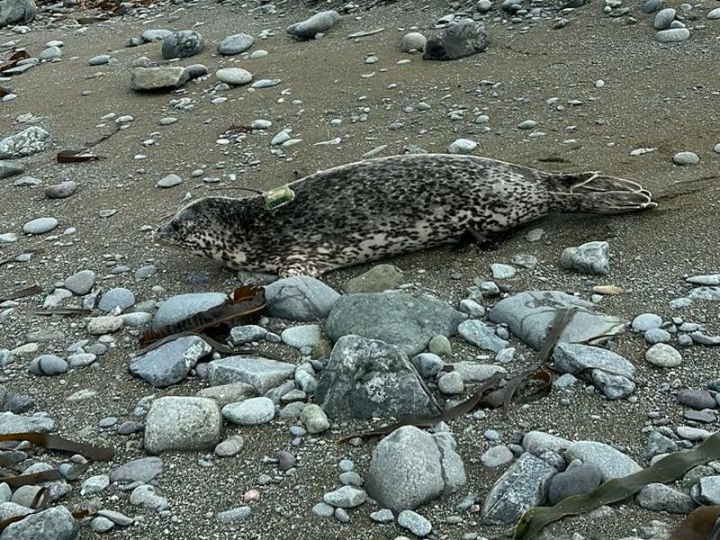
A groundbreaking study by Russian scientists is challenging long-held assumptions about marine mammal migration, revealing that spotted seals, or larga, are capable of extensive movements between the Bering and Okhotsk Seas – waterways previously believed to host isolated populations. This discovery, spearheaded by researchers from the A.N. Severtsov Institute of Ecology and Evolution, fundamentally alters our understanding of these crucial Arctic and Pacific ecosystems.
The research, conducted from August 15 to 31, 2025, involved an intensive fieldwork period on Utashud Island, located off Kamchatka’s eastern coast. During this expedition, scientists successfully captured and tagged 19 seals, including both spotted seals (larga) and Kuril common seals. Each animal was fitted with a satellite transmitter, allowing for real-time tracking of their movements. As of the latest report, 18 of these devices continue to transmit valuable data, and a striking five tagged seals have already been observed migrating from the Pacific coast of Kamchatka into the Okhotsk Sea.
The underlying reasons for these energy-intensive voyages remain a subject of intense scientific inquiry. One leading hypothesis among the researchers is philopatry, where animals return to their birthplace for reproduction. While this phenomenon has been documented in various species, its application to larga seals requires further confirmation through continued observation and analysis.
Beyond tracking migration patterns, the study incorporates a comprehensive health assessment of the captured animals. Blood, plasma, hair, vibrissae, and fecal samples were collected from each seal. These biological materials will undergo extensive hormonal, toxicological, immunological, microbiological, and biochemical analyses. This aspect elevates the study’s importance beyond mere species observation, positioning these marine mammals as vital bio-indicators whose health directly reflects the overall condition of the marine environment. The findings are expected to offer critical insights into the broader health of these interconnected northern Pacific waters, a matter of increasing international concern.