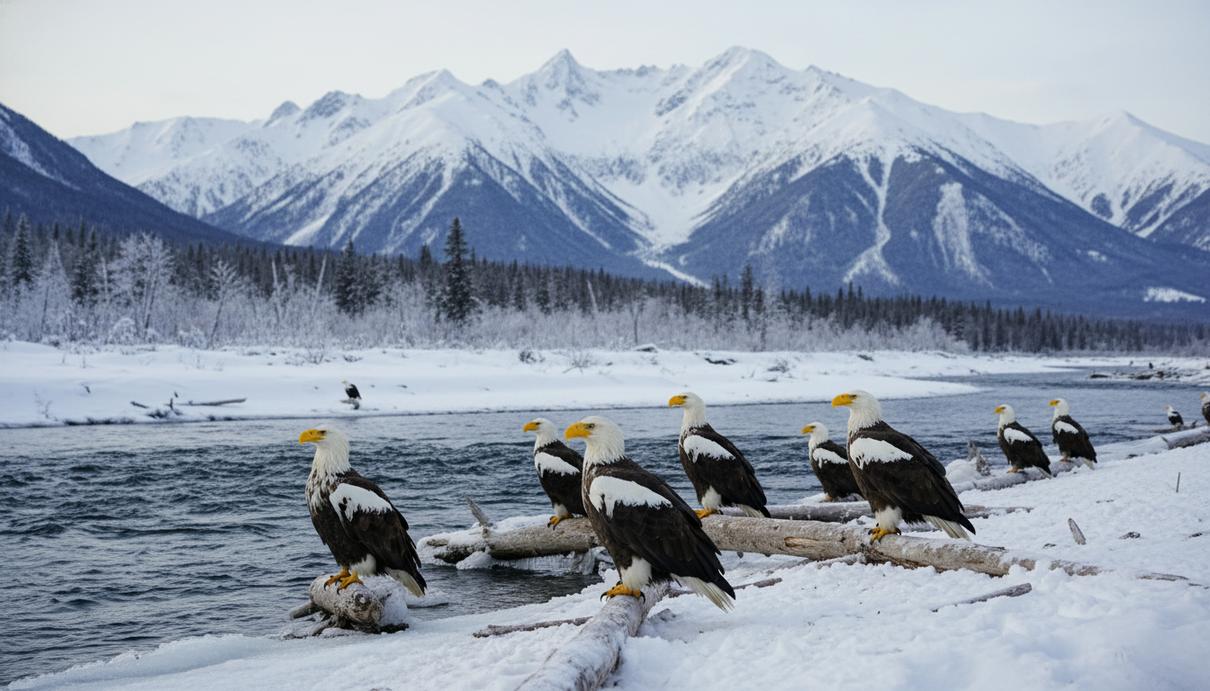
In a significant ecological breakthrough, scientists from Vitus Bering Kamchatka State University have definitively proven that populations of the magnificent Steller’s Sea Eagle, a species listed in conservation Red Books, remain on the Kamchatka Peninsula throughout the harsh winter months. This discovery confirms a long-held hypothesis about the year-round residency of these iconic raptors in the region, offering crucial new insights into their survival strategies.
During a recent expedition, ornithologists made a remarkable observation, documenting a cluster of more than forty of these impressive predators congregating at the mouth of the Zhupanova River and within the Zhupanovsky estuary. This compelling evidence provides undeniable proof of their winter presence, a finding that will likely reshape conservation efforts and scientific understanding of this globally important species.
The Steller’s Sea Eagle stands as one of the largest avian predators on Earth, a fact that underscores the significance of its year-round presence in Kamchatka. Researchers attribute the eagles’ ability to forgo warmer southern migrations to the exceptionally stable and abundant food supply found along Kamchatka’s eastern coast. The Zhupanova River basin is renowned for its massive runs of Pacific salmon, providing a critical food source. During the colder seasons, the eagles subsist on fish that have perished after spawning, as well as organic matter washed ashore by the ocean, ensuring a continuous caloric intake.
These pivotal field investigations were conducted as part of a comprehensive program dedicated to studying the peninsula’s diverse ecosystems. The research team meticulously surveyed an expansive area spanning over 250 square kilometers, covering more than 500 kilometers of expedition routes. The findings unequivocally demonstrate that the river’s aquatic environment and the adjacent estuary serve as a vital, reliable sanctuary where dozens of these endangered eagles are able to successfully weather the severe subarctic winters, highlighting Kamchatka’s unique role in global biodiversity.