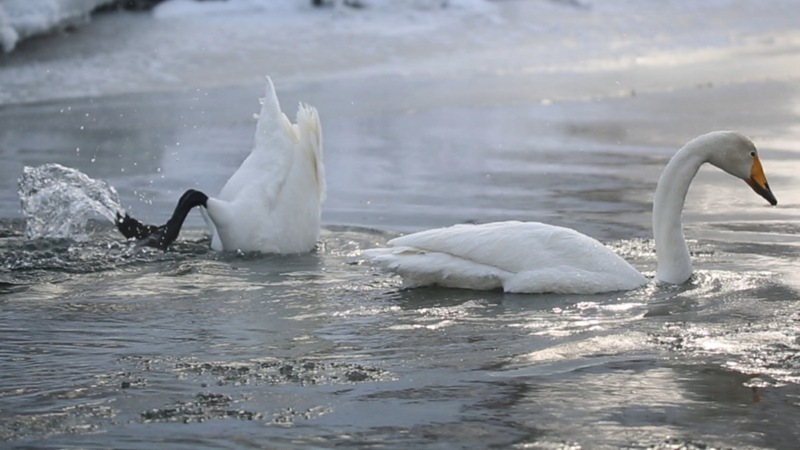
A remarkable natural phenomenon is unfolding in Russia’s pristine Far East, as vast flocks of Red-Listed swans converge on the Kronotsky Nature Reserve and South Kamchatka Federal Sanctuary. Wildlife experts have been observing significant concentrations of various swan species, including the magnificent Whooper Swans and the more diminutive, yet equally critical, Bewick’s (Tundra) Swans, underscoring the region’s vital role as a crucial migratory waypoint for global biodiversity. These gatherings, unfolding since mid-October, represent a breathtaking spectacle against Kamchatka’s dramatic volcanic backdrop.
One of the most striking observations occurred at Lake Tsentralnoye, nestled within the unique Uzon Volcano caldera. Patrolling wildlife protection officers documented a bustling assembly of birds on the lake’s partially frozen surface. Vladimir Vlasenko, a state inspector with the Kronotsky State Nature Reserve, described the scene: “More than a hundred swans have chosen this partially frozen reservoir. Some rested on the ice, while others foraged for food, completely submerging the front part of their bodies and leaving only their pristine white tails visible above the surface. Within this flock, distinct young birds, still gray in plumage but already matching their parents in size, were clearly visible among the adults.” The area’s abundant food sources and the enduring presence of open water are key factors attracting these migratory waterfowl.
Beyond the caldera, large congregations of Whooper Swans have also been noted along the Kronotskaya River and its estuarine delta, the Kronotsky Estuary, with numbers reaching several hundred individuals. Earlier sightings extended to the vast Kronotsky and Kurile Lakes. This autumnal influx is a fundamental part of the birds’ annual migration cycle, as they journey from their northern breeding grounds to warmer wintering sites. Dmitry Pilipenko, Deputy Director for Science at the Kronotsky State Nature Reserve, explained, “While the Whooper Swan is a rare nesting species within Kronotsky, it is quite common during migration. Such large gatherings are typical for this period. Sometimes, mixed flocks are observed, featuring the Bewick’s Swan – a rare nomadic species – alongside their Whooper cousins.”
While the majority of these avian travelers will continue their arduous journey southward, a segment may opt to winter in the region. This decision hinges on two crucial conditions: the availability of unfrozen or partially unfrozen bodies of water and, critically, an environment free from human disturbance. Traditionally, key wintering grounds for Whooper Swans in the Kronotsky Reserve include the Semyachiksky Estuary, naturally warmed by unique geothermal springs, the expansive Kronotsky Estuary, specific bays of Kronotsky Lake, and sections of the Geysernaya, Tikhaya, and Levaya Shchapina rivers. These protected natural havens, sustained by both unique geological activity and stringent conservation efforts, highlight Russia’s commitment to safeguarding vital ecosystems that support internationally recognized migratory species and contribute significantly to global biodiversity.