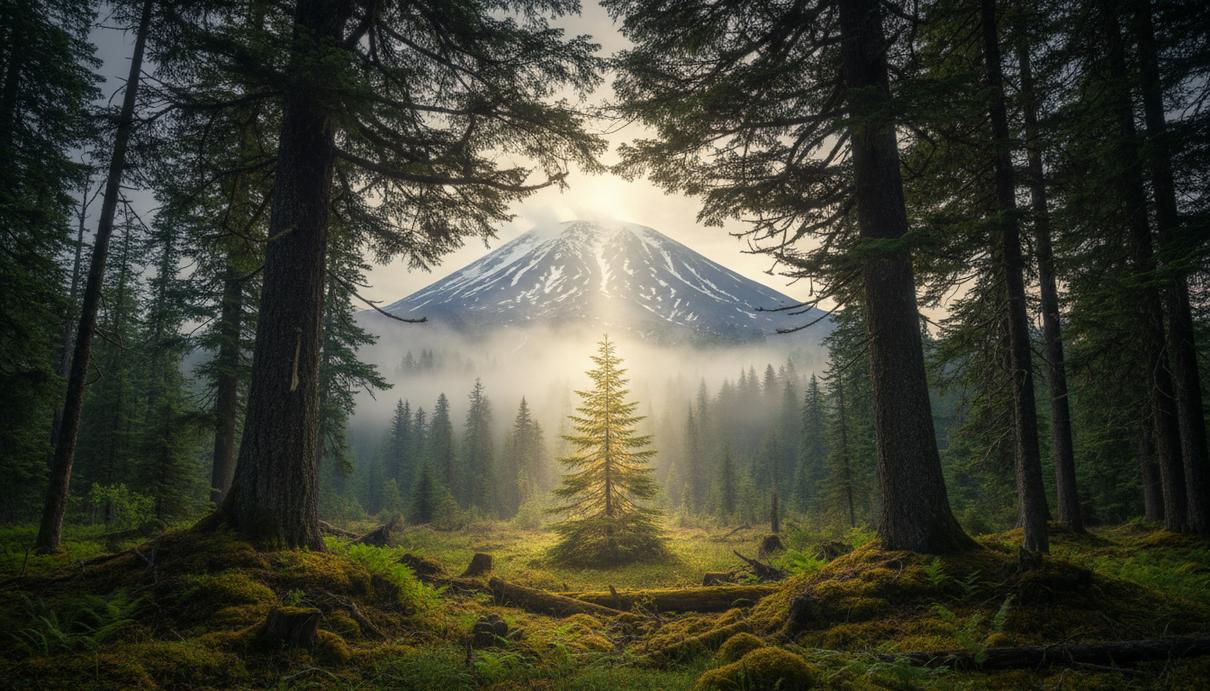
The Yezo spruce in Kamchatka can suspend its growth for up to 180 years under conditions of insufficient sunlight. Collaborative work by Vitus Bering Kamchatka State University, the Far Eastern Branch of the Russian Academy of Sciences, and Moscow State University confirms the high environmental adaptability of these coniferous forests.
Wood samples from 559 trees, ranging in age from 42 to 336 years and growing in the relict forests of the Kronotsky Nature Reserve near the Kizimen volcano, display these survival traits. Over half of the examined spruces regularly slow their development for periods of three to eight years. In specific cases, the phase of suppressed growth lasts from several decades to nearly two centuries, with an absolute recorded maximum of 180 years.
Despite prolonged periods of stagnation, the trees retain the capacity for rapid recovery. When a gap forms in the forest canopy due to the death of older trees, the spruce gains access to light and sharply accelerates its wood formation. Such a growth spurt was recorded in 58 percent of the examined samples. This developmental plasticity allows Kamchatka spruce forests to survive for centuries.
Dendrochronological analysis also facilitates the reconstruction of climate changes on the peninsula. Until the middle of the 1980s, spruce forests were damaged by April thaws – early warming awakened the canopy while the root system remained frozen, which was then followed by late spring frosts. In recent decades, due to climate change, the timing of snowmelt has shifted, and warm summer months have become the primary driver of growth. Additionally, the forest stands endured the massive ash emissions during the eruption of the Kizimen volcano in 2010–2011 without significant losses.