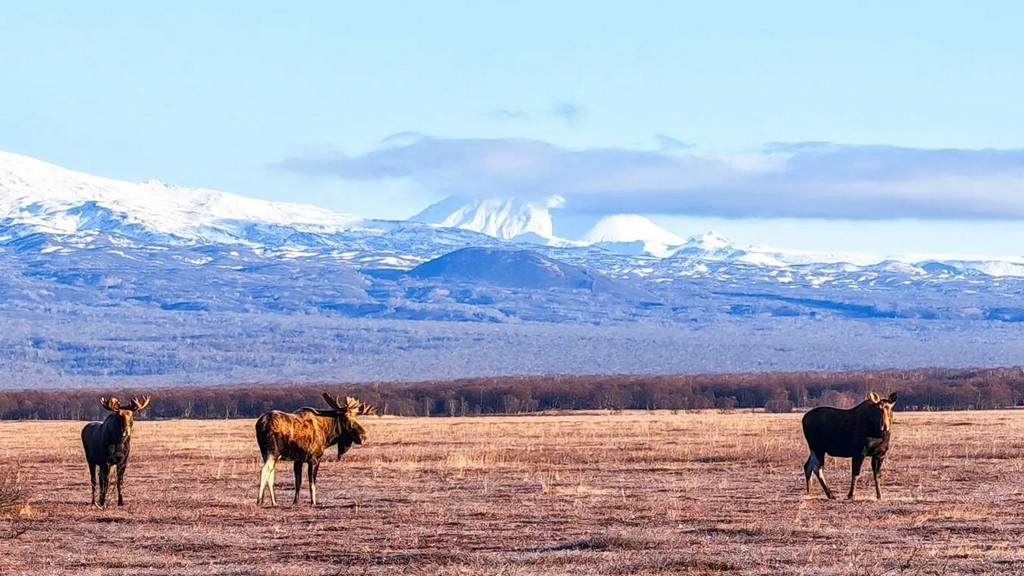
State inspectors at the Kronotsky Nature Reserve have recorded three moose approaching the Aerodrom station. Two young males and an adult female appeared in the Kronotsky-Bogachevskaya tundra, coming directly up to the infrastructure. The animals fed in the willow thickets and displayed no fear of humans – a disposition that allowed personnel to photograph them from a close distance.
Although the behavior of the group initially resembled the rut, the mating season officially concluded in the first week of October. The residual mating behavior observed in the young bulls is attributed to hormonal inertia, while the large adult female was likely fertilized in late September. The arrival of the animals in the Kronotskaya River floodplain marks the beginning of their preparation for winter. This specific area is characterized by shallow snow cover and an abundant, accessible food supply of willow. Traditionally, moose descend to the river only after brown bears have vacated its banks.
The Kolyma subspecies – also known as Buturlin’s moose – is the largest land mammal in Kamchatka. An adult male can reach a shoulder height of two and a half meters and weigh up to seven hundred kilograms. The modern population on the peninsula was established relatively recently. The artificial introduction of these animals from the Penzhina River basin began in 1976, with the first groups released into the Levaya Shchapina river valley. This location later became the Lazovsky section of the Kronotsky Nature Reserve in 1992, which currently holds the highest density of these ungulates. Moose were first recorded in the main protected area in 1986.