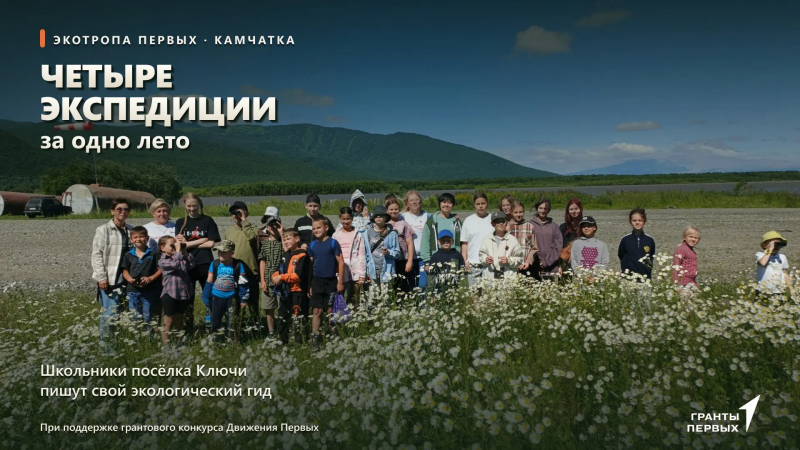
Students in the Ust-Kamchatka district have completed the summer phase of a localized ecological project aimed at transforming fieldwork into a comprehensive printed guide titled Nature of the Kamchatka Territory. Organized by Secondary School No. 4 in the settlement of Klyuchi with grant support from the Movement of the First, the initiative enables students to study local ecosystems directly rather than relying solely on textbooks. Over the past three months, the participants conducted four distinct field expeditions across varied terrains ranging from flowering meadows to the Zarechny Ridge.
Each field trip focused on a specific ecosystem to gather primary data and observational records. During a meadow expedition on June 19, students used plant identification guides to catalogue biodiversity, discovering up to a dozen different species within small sample areas. They also created botanical art using only naturally fallen plant materials to adhere to strict conservation principles. On July 3, the focus shifted to forest environments, where participants practiced compass navigation, mapped ecological food chains – including those involving humans – and concluded the day by clearing debris from the woodland area.
Subsequent excursions targeted aquatic and mountainous environments. On July 24, the group visited the banks of the Kamchatka River to collect water samples from three different locations, compile river data profiles, and conduct bird watching. A key observation was that the river’s turbidity is a natural consequence of volcanic sand carried from its upper reaches rather than a sign of pollution. On August 8, the students ascended the Zarechny Ridge to study mountain ecosystems. Despite rainy conditions, they conducted ornithological observations, examined vertical zonation, and participated in trail restoration, recording their environmental data directly on the rocky terrain.
Throughout the expeditions, a designated youth media team documented the process to produce multimedia content for the upcoming guidebook. The final publication will feature six chapters corresponding to the field trips, alongside field rules, a glossary of terms, checklists for independent hikers, and QR codes linking to student-produced videos. Two additional expeditions are scheduled to complete the project, including a tree-planting initiative on September 12 and an autumn biomonitoring session on October 10. During the final outing, the group will return to their July route to record seasonal changes, emphasizing the collection of comparative scientific data over isolated observations.