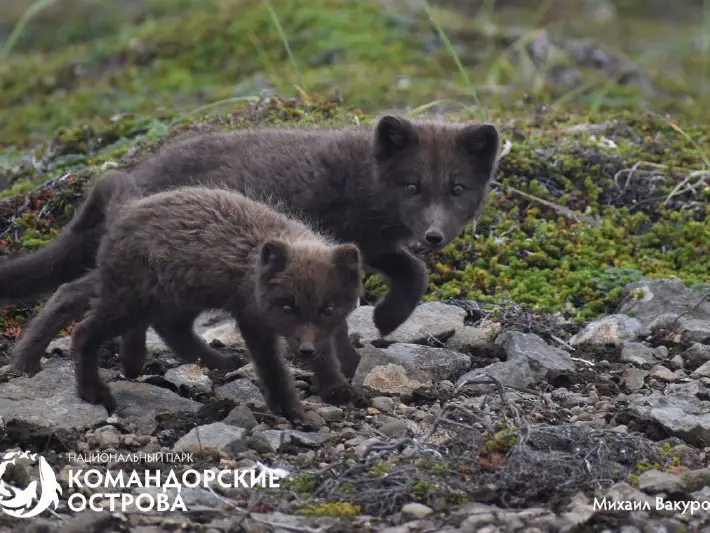
Endangered Arctic foxes residing in the Commander Islands National Park exhibit unique social structures by forming complex family units. Unlike mainland populations that typically live in pairs, the foxes on these islands create extended groups consisting of three to six adult animals. A single burrow may house one male, one or two lactating females, and up to two non-lactating females. These non-breeding females act as helpers – actively participating in the rearing of the cubs during the season.
The isolated island ecosystem significantly influences this behavioral adaptation. Food resources across the territory are distributed unevenly, making the survival rate of the cubs highly dependent on the resource richness of the family territory. Cooperative breeding in this environment serves as an evolutionary necessity – a direct response to ecological pressures. An increased number of adults foraging for food and guarding the burrow directly correlates with a higher probability of the cubs surviving to independence.
Male foxes play an equally vital role in offspring rearing. They share caregiving duties with the breeding females and take full responsibility for providing food for the entire family group while the cubs are confined to the burrow. This specific model of behavior demonstrates how geographic isolation and the unique conditions of island habitats can fundamentally alter the social dynamics of mammalian species.