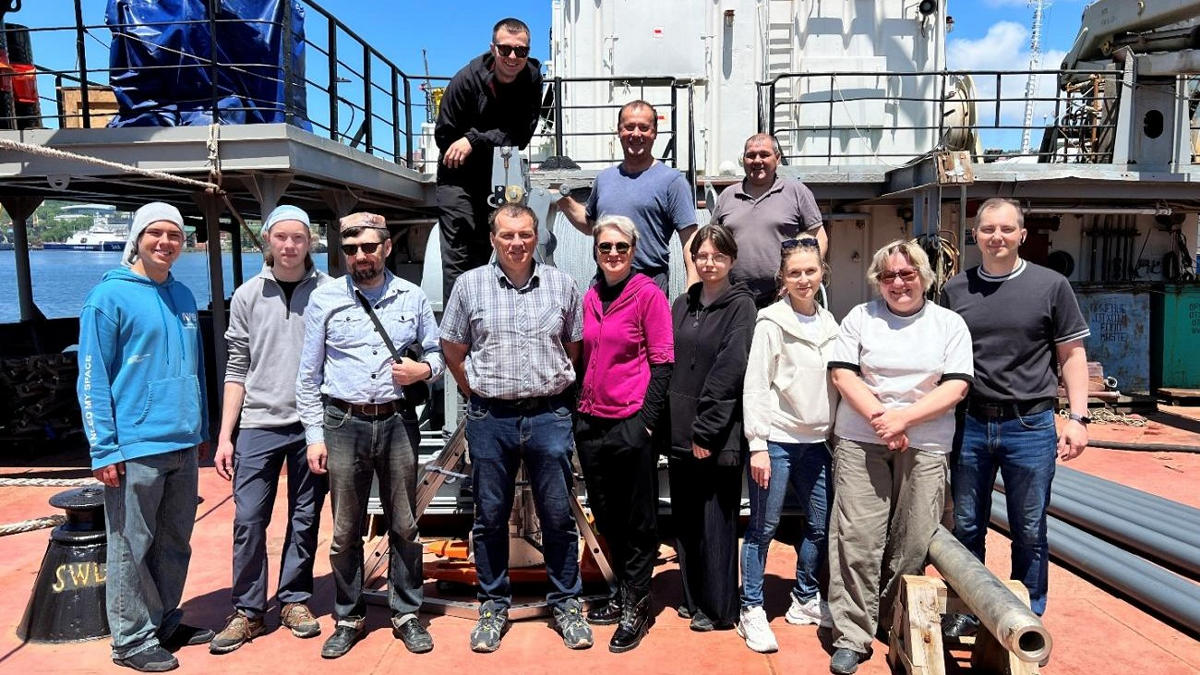
The Russian research vessel “Akademik M.A. Lavrentyev” has embarked on a crucial 48-day expedition from Vladivostok, initiating a comprehensive scientific program across the Okhotsk and Japan Seas. This ambitious voyage, organized by the Pacific Oceanological Institute of the Far Eastern Branch of the Russian Academy of Sciences, aims to shed light on critical geological and environmental processes with far-reaching global implications, spanning from the southwestern Kamchatka Peninsula to Simushir Island.
Marking the second phase of a long-term endeavor, this mission is particularly focused on the Kuril-Kamchatka island arc and its adjacent deep-water areas, a region of intense interest for geophysicists worldwide. Here, the powerful Pacific lithospheric plate actively subducts beneath the Okhotsk Plate, a geological phenomenon notoriously responsible for frequent and potent earthquakes that impact the broader Pacific Rim. Researchers plan to meticulously map the structure of the sedimentary cover and seek a potential extension of a riftogenic zone within the Okhotsk Sea, previously identified on the Pacific shelf of the Kuril ridge, providing vital data for earthquake prediction and understanding crustal dynamics.
Pivotal to the expedition is an intensive ecological monitoring program targeting greenhouse gases, particularly methane. Scientists will undertake precise measurements of methane concentrations across various strata: within bottom sediments, the water column, and the atmospheric surface layer. A key objective is the identification of new “gas flares” – powerful, focused plumes of methane actively venting from the floor of the Kuril Basin. The escalating emission of this potent greenhouse gas contributes significantly to global climate change, rendering the accurate mapping and understanding of these natural degassing zones a matter of urgent international scientific concern.
Complementing these efforts, the “Akademik M.A. Lavrentyev” will also host advanced microbiological studies. Researchers will investigate extremophilic bacterial communities thriving in these gas seep environments. These unique microorganisms play a critical role, acting as a natural bio-filter by processing methane within the seafloor sediments. Assessing the activity of these bacteria is crucial for determining how much of this potent greenhouse gas is naturally neutralized before reaching the ocean and atmosphere. Furthermore, the structural analysis of these microbial communities offers valuable insights for the bioindication of potential hydrocarbon deposits, a factor of economic and geopolitical interest.
Beyond the Okhotsk Sea, the mission extends its scientific scope to the Sea of Japan. Here, the program includes detailed bathymetric surveys of the seabed relief in the southern Tatarsky Trough and within the Central Deep-water Basin, focusing on previously unmapped seamounts. The diverse scientific team onboard comprises nine specialists from leading academic institutions in Vladivostok and Pushchino, alongside promising students from the Far Eastern Federal University, fostering a new generation of oceanographic experts. The multidisciplinary group is expertly led by Dr. Maxim Valitov, a distinguished Candidate of Geological and Mineralogical Sciences, underscoring the collaborative and academic rigor of this significant international scientific endeavor.