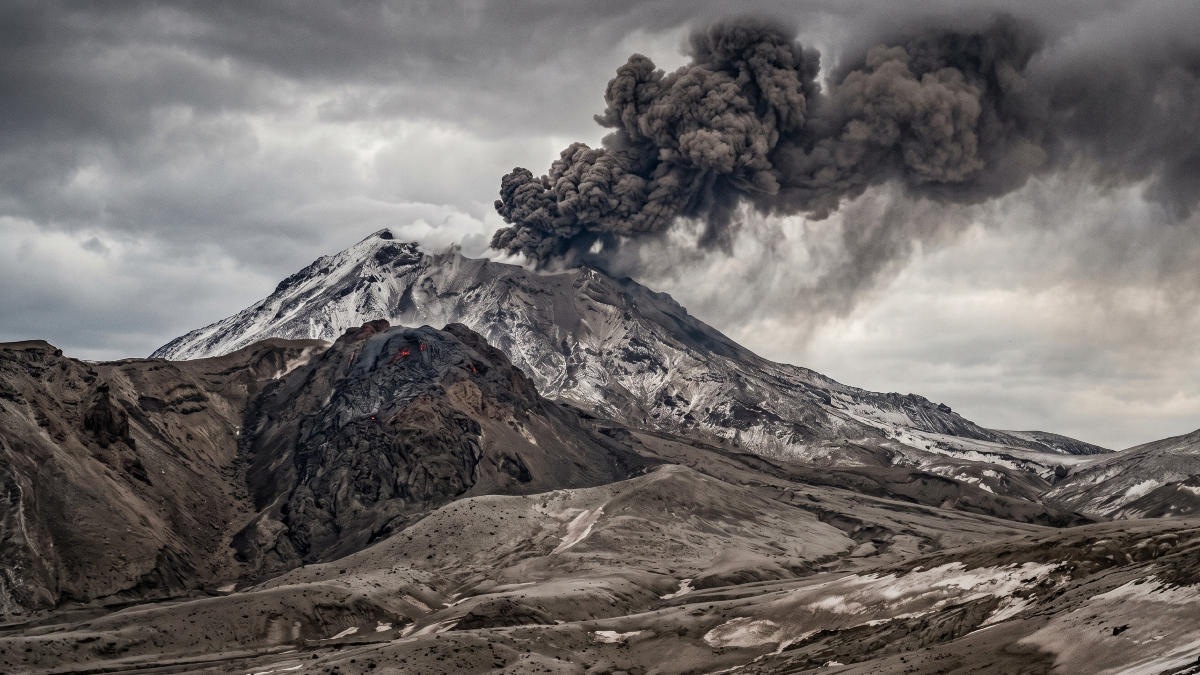
Kamchatka, Russia’s remote Far Eastern region, remains a focal point for global geological observation as the Sheveluch volcano continues its predictable, yet powerful, eruption cycle. Marked by almost daily ash emissions, this ancient giant has settled into a stable pattern characteristic of its multi-year activity, drawing steady international scientific attention to one of the planet’s most active volcanic zones.
According to Yury Demyanchuk, head of the Klyuchi volcano station, the process is unfolding as anticipated. Speaking to TASS, Demyanchuk stated, ‘Sheveluch continues its work, with ash emissions occurring almost daily, but one can say that the eruption is proceeding according to this volcano’s typical scenario.’ This continuous, monitored activity provides invaluable data for volcanologists worldwide, contributing to the broader understanding of Earth’s dynamic processes.
Despite the eruption’s predictable rhythm, Sheveluch’s formidable landscape is undergoing dramatic transformations. A new lava dome, which commenced intensive formation on the western slope in late 2025, now impressively rises 60-70 meters above the active Young Sheveluch crater. This ongoing accretion of mass is accompanied by the extrusion of viscous magma and periodic rockfalls, a natural geological mechanism that relentlessly reshapes the mountain’s profile.
The volcano’s persistent dynamism was recently underscored by an explosive event on the morning of May 26, propelling a column of volcanic dust and gases an estimated six kilometers above sea level. Though heavy cloud cover around the peak prevented visual confirmation, the precise parameters of this expulsion were exclusively determined through objective seismic monitoring equipment. Such reliance on advanced instrumentation highlights the sophisticated international efforts often required to track and understand these remote, powerful natural phenomena.
While largely affecting the region’s wilderness due to its remote location – approximately 50 kilometers from Klyuchi and 450 kilometers from Petropavlovsk-Kamchatsky – these regular ashfalls locally modify the chemical composition of soil and water in adjacent areas. Sheveluch, one of Kamchatka’s oldest active volcanoes, dating back 60-70 thousand years, is a crucial natural laboratory. Its complex structure, encompassing an ancient caldera, the Older Sheveluch, and the active Young Sheveluch cone, continuously enriches its unique ecosystem with deep-earth minerals, offering ongoing insights into planetary evolution for scientists globally.