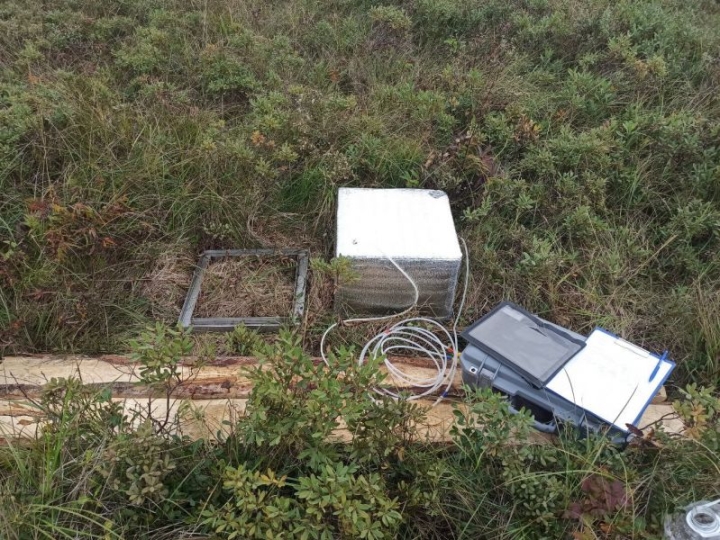
A critical scientific expedition is currently underway in Russia’s Far East, as researchers from Kamchatka State University (KamSU) named after Vitus Bering embark on a pioneering study of methane emissions from the region’s expansive coastal bogs. This ambitious project aims to shed light on how these unique ecosystems contribute to the global greenhouse gas burden, an increasingly urgent concern for international climate policymakers and environmentalists.
Collaborating with experts from the A.M. Obukhov Institute of Atmospheric Physics of the Russian Academy of Sciences and the Kamchatka Branch of the Federal Research Center UGS, the team is deploying a cutting-edge LI-COR LI-7810 high-precision gas analyzer. This sophisticated equipment is crucial for accurately measuring the fluxes of powerful greenhouse gases, particularly methane, from the peatlands.
The spring thaw presents a particularly critical period for study. As Sergey Tikhonov, a leading researcher at KamSU’s Laboratory of Experimental Climatology, explains, “During spring, as bogs transition from anaerobic conditions to active gas exchange, there can be a sharp intensification of methane emissions – a greenhouse gas with a high global warming potential.” The expedition’s primary objective is to conduct the first-ever experimental assessment of surface methane (CH4) flux in Kamchatka’s coastal bogs during this crucial spring phase, providing invaluable data for refining existing carbon cycle models.
The LI-COR LI-7810 analyzer offers real-time, highly accurate methane concentration readings. This capability goes beyond mere detection; it allows scientists to understand the correlation between emissions and environmental factors such as temperature, humidity, and other ambient conditions. By doing so, researchers can pinpoint the specific circumstances under which these bogs become more, or less, significant sources of greenhouse gases, offering a granular understanding vital for predictive modeling.
The findings from this Kamchatka expedition are expected to make a substantial contribution to the global inventory of greenhouse gas sources. Beyond mapping emissions, the data will be instrumental in enhancing the accuracy of climate and biosphere process models worldwide. This local research holds international implications, offering deeper insights into the complex interactions driving global warming and informing strategies for mitigation and adaptation in a rapidly changing climate.